
Business Partners
Basic Approach
The Sumitomo Heavy Industries Group expands our global business, we are striving to build mutually constructive and healthy relationships with our suppliers while simultaneously working to reduce our environmental, social, and governance (ESG) risks throughout our supply chain in addition to the traditional areas of costs, quality, and delivery date.
We promote responsible procurement activities throughout our supply chain by conducting our own transactions in a fair, equitable, and transparent manner and by working with suppliers to address sustainability issues, while placing importance on respect for human rights, rigorous compliance, environmental conservation, and other considerations.
Based on “Sumitomo’s Business Philosophy” as well as our Group’s “Purpose” and “Business Principles,” the Sumitomo Heavy Industries Group aims to provide products and services that help advance economic and technological development toward realizing a sustainable society.
To achieve this aim, we have established these CSR Procurement Guidelines. The cooperation of all Group suppliers is essential to the success of these initiatives. Therefore, we request your understanding and cooperation in promoting the items set forth herein.
- 1Fair and equitable competition and transactions and thorough attention to compliance
- Compliance with all business laws and regulations
- Realization of fair and equitable competition and transactions
- Protection of and respect for intellectual property
- Prohibition of the offering of improper advantages
- Compliance with laws and regulations related to import and export
- Preservation of confidentiality
- Responsible mineral procurement
- Severing of relations with antisocial forces
- Establishment of an internal reporting system
- 2Human rights, labor, and health and safety
- Compliance with labor laws and regulations
- Respect for human rights and prohibition of unfair discrimination, labor, and harassment
- Prohibition of child labor and forced labor
- Occupational health and safety
- Appropriate management of working hours and consideration for living wages
- Respect for freedom of association and collective bargaining
- 3Consideration of the environment
- Compliance with relevant laws
- Establishment of an environmental management system
- Prevention of environmental pollution and control of hazardous chemical substances
- Effective use of resources/energy and reduction of negative environmental impact
- Consideration for biodiversity
- 4Promotion of communication with stakeholders through information disclosure
- 5Social contribution and coexistence/co-prosperity with local communities
- 6Application throughout the supply chain
CSR Procurement Promotion System
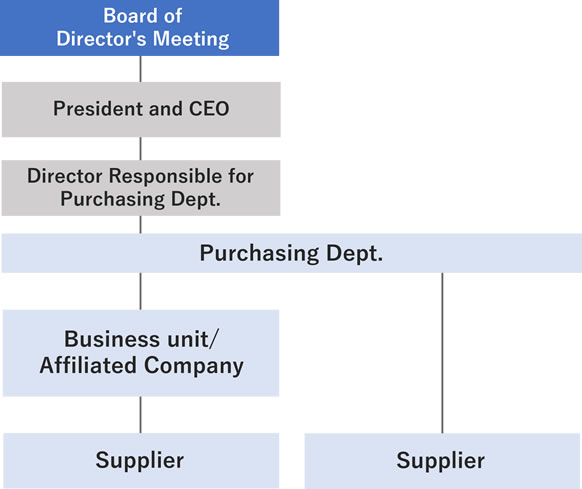
In our group, the Purchasing Div. works with Strategic Business Units (SBUs) and Affiliated Companies to promote CSR procurement throughout our group.
At the Procurement Managers' Meeting, which comprises procurement managers from the Purchasing Div., SBUs, and Affiliated Companies, company-wide policies and activity plans are shared to ensure that procurement activities are conducted in accordance with our CSR Procurement Guidelines.
Important matters, targets, and progress are deliberated and approved by the Board of Directors. In addition, education on CSR procurement is provided through training sessions organized by the Purchasing Div.
Approaches to CSR Procurement Implementation
Initiatives within Our Group
Procurement Manager Meeting
The Purchasing Div. hosts this group-wide meeting twice a year.
At this meeting, we communicate and promote understanding of group-wide policies on sustainability, procurement compliance, and human resource development.
| Most recent meeting date | October 9, 2025 |
|---|---|
| Attendees | Officer Responsible for the Purchasing Div. and Procurement Managers of SBUs and Affiliated Companies |
| Contents | Human Rights Due Dilligence in the supply chain, Responsible Mineral sourcing, Environmental response |
CSR procurement training
The Purchasing Div.provides CSR procurement training as part of an education course for procurement departments' personnel.
This year, we covered sustainability trends, approaches to CSR procurement, and responses to Responsible Mineral Procurement.
| Number of trainees | |
|---|---|
| FY2025 | 460 persons (Percentage of procurement personnel attending: 100%) (Targeted personnel: Procurement personnel of our company and its domestic affiliated companies) |
Supplier Survey
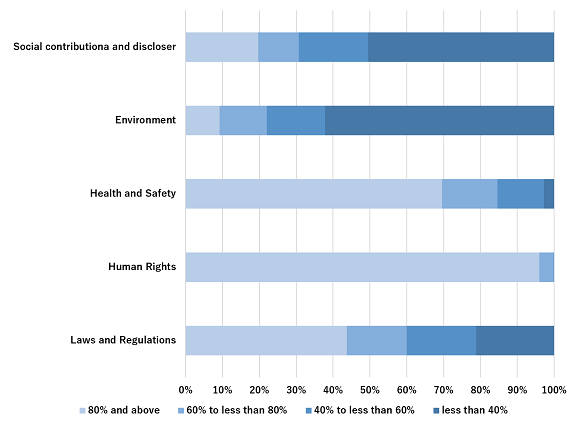
We conduct a questionnaire survey of our key suppliers every two years. In fiscal 2024, we invited 702 key suppliers, collectively accounting for the top 80% of our group's total procurement spend, to participate in the survey and received responses from 573 of them.
Supplier Survey and Summary of Results
| Number of responding companies | 573 companies |
|---|---|
| The response rate of key suppliers | 81.6% |
| Question Structure | Questions designed to measure each company's understanding and implementation level according to the CSR Procurement Guidelines |
On-site Survey
Japan
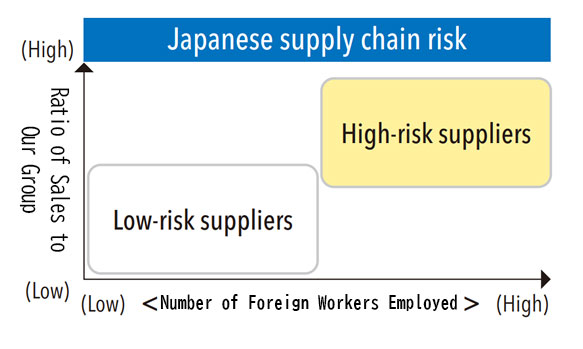
As a key initiative for “Building a Sustainable Supply Chain,” our group is committed to respecting the human rights of foreign workers, who are considered particularly vulnerable to human rights abuses.
Based on the number of foreign workers employed and the ratio of sales to our group, we have identified 24 suppliers for priority follow-up and defined them as “potentially high-risk suppliers.” We are conducting on-site surveys with the aim of completing surveys of all target suppliers by 2026 and encouraging corrective action where necessary.
Overseas
Based on the Human Rights Risk Project's analysis of risks in overseas supply chains, we conduct supplier surveys with a primary focus on manufacturing sites.
For overseas on-site surveys, we also conduct audits through a third-party organization.
Results of On-site Survey for FY2025
| (Japan)Number of Potentially High-Risk Suppliers | 5 companies |
|---|---|
| (Japan)Number of Suppliers Surveyed Based on Questionnaire Results | 5 companies |
| (Japan)Suppliers Engaged with on Environmental Issues | 3 companies |
| (Overseas)Number of On-Site Surveys | 4 companies (Indonesia, India) |
As a result of on-site surveys conducted at 17 suppliers in FY2025, no serious human rights violations or compliance breaches were identified. However, we requested improvements in certain areas, including the installation of evacuation route maps and measures to support foreign workers who do not understand Japanese.
Topics
Promoting Sustainability in the Supply Chain through Collaboration with Kawasaki Heavy Industries, Ltd.
■Presentation at a Seminar for Suppliers
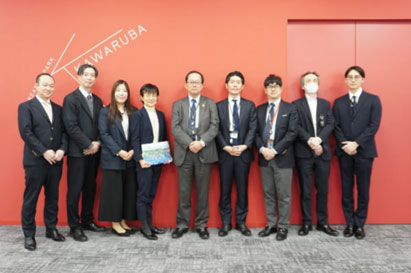
In January 2026, we gave a presentation at a seminar for suppliers hosted by Kawasaki Heavy Industries, Ltd., introducing our environmentally and socially responsible initiatives and our responsible procurement activities throughout the supply chain. We also explained the challenges we recognize in achieving carbon neutrality, our future direction, and the areas in which we seek suppliers' cooperation.
■CSR Procurement Information Session
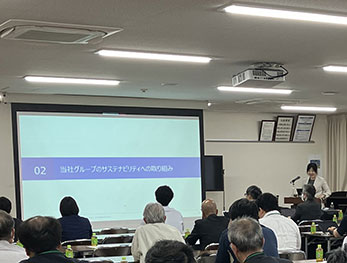
In June 2026, following the revision of the CSR Procurement Guidelines, we held a CSR procurement information session for business partners at the Niihama Factory of Ehime Works. Held in a hybrid format combining in-person attendance and online streaming, the session was attended by representatives from more than 400 business partners.
At the session, we explained our CSR Procurement Guidelines and our initiatives relating to human rights, labor, and the environment in the supply chain. Kawasaki Heavy Industries, Ltd. also gave a presentation on its supply chain management initiatives and practical examples of its efforts.
■Looking Ahead
Through collaboration with Kawasaki Heavy Industries, Ltd. and other companies, we are promoting initiatives to address sustainability issues throughout the supply chain. We will continue to promote responsible procurement activities and work to build a sustainable supply chain through dialogue and collaboration with our business partners.
Related Information
Responsible Minerals Procurement
Based on the Responsible Minerals Procurement Policy, we identify risks in accordance with the "OECD Due Diligence Guidance for Responsible Supply Chains of Minerals from Conflict-Affected and High-Risk Areas" issued by Organisation for Economic Co-operation and Development (OECD).
The SHI Group is committed to promote Responsible Mineral Procurement to ensure that it is not complicit in human rights violations, labor problems, environmental destruction, and other risks associated with the process of mining and trading minerals in the Democratic Republic of Congo (DRC) and neighboring countries and Conflict-Affected and High-Risk Areas (CAHRAs).
The Dodd-Frank Wall Street Reform and Consumer Protection Act of 2010 and the EU Conflict minerals Regulation of 2021, among others, and increasingly requiring companies to conduct due diligence to ensure that the mineral resources they procure do not contribute to conflicts or human rights violations.
Our company, taking reference from the "OECD Due Diligence Guidance for Responsible Supply Chains of Minerals from Conflict-Affected and High-Risk Areas" issued by Organisation for Economic Co-operation and Development (OECD), will establish a promotional framework to ensure Responsible Mineral Procurement.
By conducting mineral surveys and verifications in the supply chain, we will ensure the elimination of products, components, and materials containing minerals with risks such as human rights violations, labor issues, and environmental problems.
We ask our suppliers to endorse our initiative and activities for Responsible Mineral Procurement and cooperate with us in excluding products, components, and materials containing minerals with risks such as human rights violations, labor issues, and environmental problems through surveys.
In the unlikely event that risks, such as smelter risk, in the supply chain, are identified, we request our suppliers to take corrective actions.
Our Group's Five-Step Approach
| STEP1 | The Sumitomo Heavy Industries Group has established a “Responsible Minerals Procurement Policy” and is committed to ensuring that it is not complicit in human rights violations, labor problems, and environmental destruction. In addition, we ask our suppliers to endorse our initiative and promote activities for responsible minerals procurement. |
|---|---|
| STEP2 | We annually identify products that require investigation and conduct surveys on mineral procurement status. We conduct surveys to identify smelters in our supply chain and share the results with our customers, thereby aiming to achieve responsible minerals procurement throughout the supply chain. The results of these surveys are reviewed by the Sustainability Committee and, when necessary, reported to the Board of Directors meetings. |
| STEP3 | We share information with suppliers and request appropriate corrective actions if any risks in the supply chain are identified based on the survey results. Furthermore, we promote awareness among our suppliers for a better understanding of responsible minerals procurement activities. |
| STEP4 | We support audits conducted under the RMI’s Responsible Minerals Assurance Process (RMAP) implemented by the Responsible Minerals Initiative (RMI) as a member of the RMI. |
| STEP5 | We publish information on our website concerning our initiatives for responsible minerals procurement. |
Survey Results
In 2025, based on customer requirements, we identified risks related to 3TG (Tin,Tantalum,Tungsten, and Gold) , Cobalt and Mica in products from the Precision Equipment and Semiconductor Manufacturing Equipment businesses.
| Number of smelters | Number of Conformant/Active smelters |
Percentage | |
|---|---|---|---|
| Tin | 145 | 56 | 39% |
| Tantalum | 45 | 36 | 80% |
| Tungsten | 70 | 35 | 50% |
| Gold | 212 | 95 | 45% |
| 3TG(Total) | 472 | 222 | 47% |
| Cobalt | 99 | 60 | 61% |
| Mica | 21 | 5 | 24% |
Active smelter: A smelter that has been scheduled to undergo an RMAP assessment.
Cooperating with External Organizations
In November 2024, We joined the Responsible Minerals Initiative (RMI), an international initiative. Our group conducts due diligence by utilizing RMI’s Responsible Minerals Reporting Templates and program that certifies which smelters are conflict-free. We aim to achieve a transparent and responsible minerals procurement process throughout the supply chain.
Green Procurement
We will endeavor to provide products with less environmental load by promoting green procurement.
Please note that the Green Procurement Guidelines have been integrated into the CSR Procurement Guidelines.