
Research begins as a NEDO-selected project to develop a regional carbon recycling system through inter-industry collaboration in the Sakata/Shonai area of Yamagata Prefecture—Striving to realize a regional green CO2 cycle utilizing CO2 derived from biomass power generation—
June 24, 2026
Sumitomo Heavy Industries, Ltd. (Head office: Shinagawa-ku, Tokyo; President and CEO: Toshiro Watanabe; hereinafter referred to as “SHI”) has been selected for “Research to Develop a Regional Carbon Recycling System in the Sakata/Shonai Area of Yamagata Prefecture” (hereinafter referred to as “the research”) as part of the “Project to Promote Implementation of Carbon Recycling Technology Through Inter-Industry Collaboration” promoted by the New Energy and Industrial Technology Development Organization (NEDO). The research will be carried out jointly with Yamagata Prefecture, Sakata City (Yamagata Prefecture), Maeta Concrete Industry Ltd. (Head office: Sakata-shi, Yamagata Prefecture; Representative Director and President: Naoyuki Maeta; hereinafter referred to as “Maeta Concrete Industry”), and Toho Acetylene Co., Ltd. (Head office: Tagajo-shi, Miyagi Prefecture; Representative Director,
President and Chief Executive Officer: Hidetoshi Horiuchi; hereinafter referred to as “Toho Acetylene”). Summit Sakata Power Corporation and The Yamagata Bank, Ltd. will also participate in the research as cooperating organizations.
To help achieve social implementation of carbon recycling, the research will focus on a small/medium-scale, decentralized, inter-industry collaborative model, in which CO2 emitters and users work together, and it will investigate the best approach to developing a CO2 supply chain leveraging the characteristics of each region in Japan.
In addition to CO2 emission sources such as biomass power plants, the Sakata/Shonai area has a concentration of diverse industries, including port functions, agriculture, and manufacturing, and is a region suitable for examining initiatives based on inter-industry collaboration.
The aim of the research will be to formulate a roadmap, focused on the Sakata/Shonai area, for social implementation based on industry-government-academia collaboration, with an eye toward developing a green CO2 cycle in the region. This will be done by ascertaining the usage needs for CO2 emitted by biomass power plants (green CO2*1), examining capture and supply methods, and carrying out a feasibility assessment of economics and value addition.
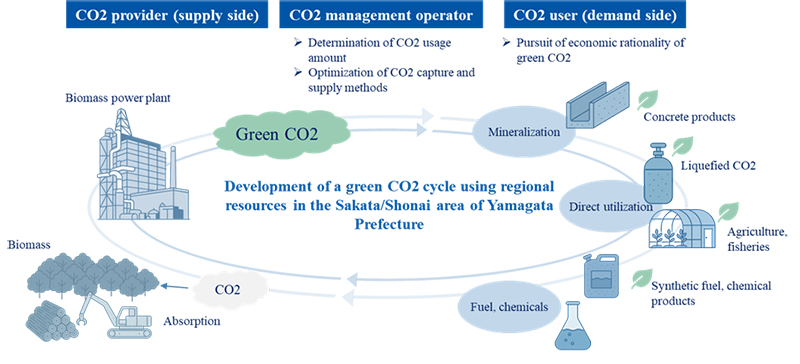
SHI has been engaged in the construction and deployment of numerous biomass power plants, both internationally and in Japan, with the aim of achieving carbon neutrality. SHI is also promoting renewable energy and working on technology relating to CO2 capture and utilization (CCU*2).
In the research, efforts to realize carbon neutrality will be advanced through studies covering technologies, institutions, and business viability, while exploiting previously cultivated knowledge, and collaborating with regional stakeholders.
| Sumitomo Heavy Industries | Overall supervision as representative company for the research, focusing on study of technologies and business viability |
|---|---|
| Yamagata Prefecture | Regional collaboration, industry collaboration, utilization of CO2 in public works, etc. |
| Sakata City, Yamagata Prefecture | |
| Maeta Concrete Industry | CO2 fixation in concrete |
| Toho Acetylene | Distribution of liquefied CO2 |
| Summit Sakata Power Corporation | Capture of green CO2*1 |
| The Yamagata Bank, Ltd. | Regional collaboration, industry collaboration |
*1) CO2 produced and captured in a renewable carbon cycle, i.e., CO2 produced primarily from biomass or processes regarded as carbon neutral
*2) CCU (Carbon Capture and Utilization) is the generic term for technologies and systems that suppress emissions into the atmosphere by capturing and effectively utilizing carbon dioxide emitted from power plants, factories, etc.