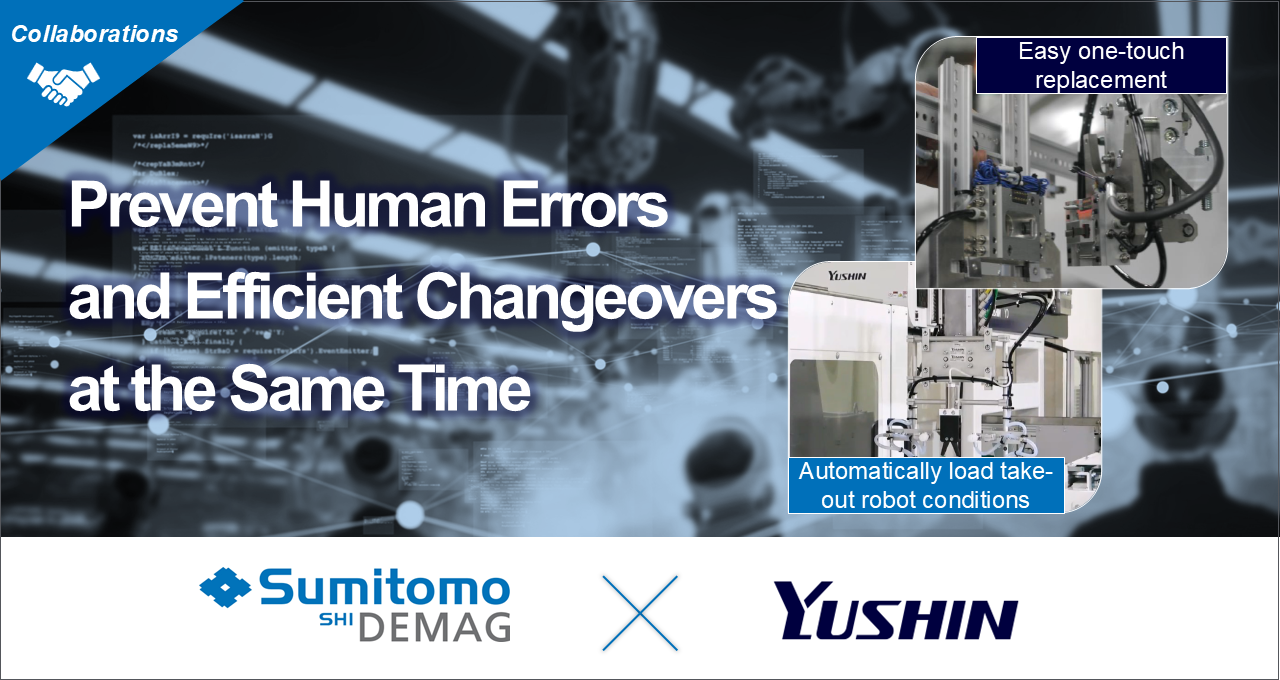
At the Popular Features Demonstration held at the Chiba Technology Center, we showcase functions that help achieve energy savings, labor savings, and workforce reduction through live demonstrations using actual machines.
In this article, we introduce one of the solutions that attracted particularly strong interest from visitors: the integration of injection molding machines and peripheral equipment.
Against the backdrop of ongoing labor shortages, many manufacturing facilities are now operating with limited personnel. During the demonstrations at the Chiba Technology Center, one of the most common concerns raised by visitors was how to perform changeover operations quickly and accurately while minimizing mistakes. Given these challenges, improving productivity is no longer limited to mass production processes. It has become increasingly important to optimize the entire operation, including setup and changeover procedures.
To address these challenges, this article introduces a solution that combines Yushin Company's "EOAT Quick-Change Unit" with Sumitomo Heavy Industries' "Linkage of Take-out Robot Conditions."
Take-out Robot Setup Process Is Often Overlooked
Have you ever forgotten to replace the EOAT or recalling individual take-out robot settings during a changeover?
While operators typically pay close attention to mold replacement and purging operations, tasks on the take-out robot side are often given lower priority and can sometimes be overlooked.
As a result, mistakes such as failing to replace the EOAT or forgetting to recall the individual take-out robot setting may occur, leading to abnormalities in part removal and unplanned production stoppages. In some cases, incorrect take-out robot settings may cause timing mismatches with mold opening operations, creating a risk of mold damage. Such troubles not only reduce productivity and require additional time and cost for recovery, but may also affect delivery schedules and customer confidence.
Even during EOAT replacement, rewiring and position adjustments can slow down the setup process and sometimes lead to rework. This can not only reduce work quality but also increase changeover time, resulting in additional production losses.
Traditionally, these kind of operations on take-out robot have relied heavily on operator experience and manual work. However, in facilities where a small number of operators manage multiple machines, the burden becomes greater and the risk of oversights and mistakes increases.
To address these challenges, Sumitomo Heavy Industries' Linkage of Take-out Robot Conditions, which automatically synchronizes robot settings with the injection molding machine, and Yushin Company's EOAT Quick-Change Unit, which improves the efficiency and reliability of EOAT replacement operations, provide an effective solution.
Linking Molding Conditions and Robot Settings
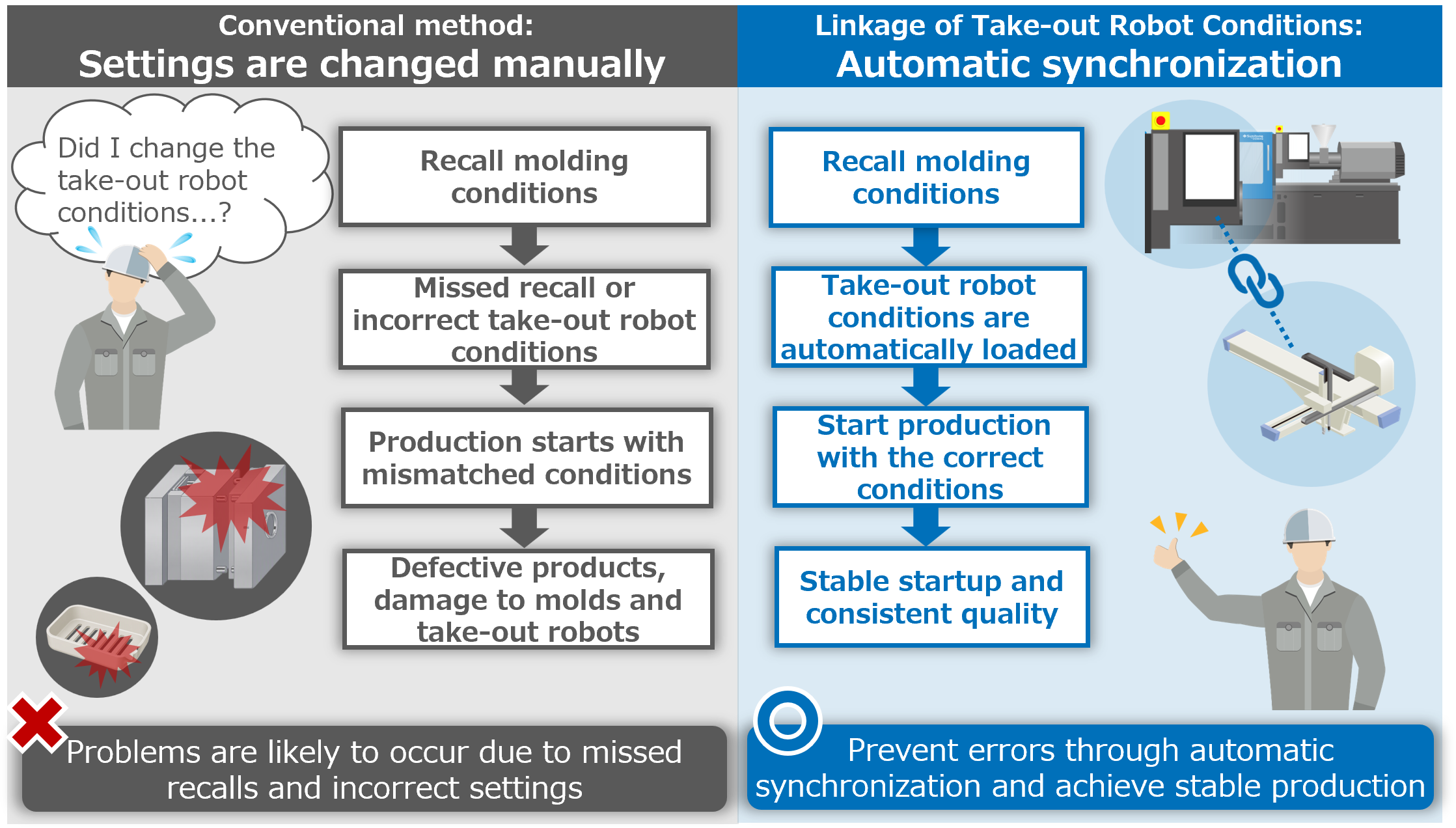
Frequent condition changeovers are common in high-mix, low-volume production environments, and with each changeover comes a greater risk of human error. In many cases, these operations still depend heavily on the operator's experience and attention.
If production is started under these conditions, defective products may be produced, and damage to molds or take-out robots may occur.
・The molding conditions were changed, but the take-out robot settings were not recalled.
・A similar robot setting was reused, but the chuck position or take-out timing was not perfectly matched.
The Linkage of Take-out Robot Conditions prevents such human errors by automatically loading the appropriate robot settings whenever molding conditions are recalled on the injection molding machine. This simplifies the process of setting up the take-out robot and helps prevent missed setting recalls.
In addition, because the molding conditions and robot settings are linked, the risk of using inappropriate robot settings for a specific product can be significantly reduced.
Reducing Take-out Robot Changeover Time
While the Linkage of Take-out Robot Conditions helps prevent setting errors, Yushin Company's EOAT Quick-Change Unit and its convenient function help reduce workload and minimize mistakes during EOAT replacement.
A Tool That Allows Anyone to Replace EOAT Easily|EOAT Quick-Change Unit
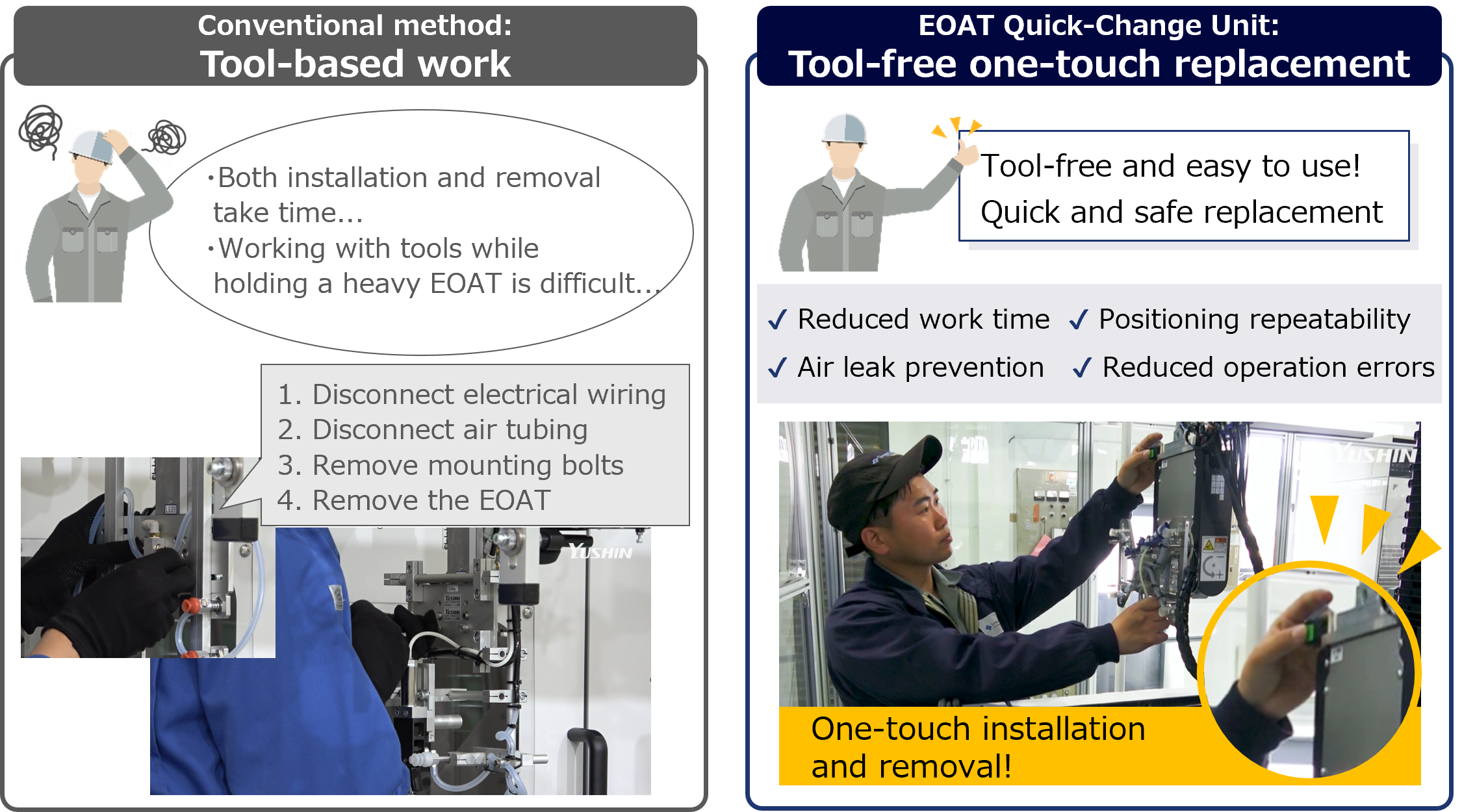
The EOAT Quick-Change Unit enables one-touch replacement of EOAT. As a result, operators no longer need to use tools or perform air tubing and wiring connections that were previously required.
This not only shortens replacement time but also helps prevent human errors such as connection mistakes and fastening errors.
Furthermore, stable positioning accuracy ensures repeatability, eliminating the need for adjustment after replacement.
By simplifying a process that previously depended on operator experience and skill, the EOAT Quick-Change Unit enables anyone to perform the work with consistent quality.
Take-out robot has a setting function registering EOAT ID in advance. If the installed EOAT does not match the registered settings, the take-out robot will not operate, preventing problems caused by forgotten replacements or incorrect EOAT installation before production begins.
Convenient Function That Eliminate Operator's Manual Adjustment
During EOAT replacement, the take-out robot must be moved to the EOAT replacement position and then returned to its standby position or safety area after the work is completed. Traditionally, operators manually moved the robot using the controller in the transverse, front-rear, and vertical directions.
With the convenient function, operators simply press a button, and the take-out robot automatically moves to a predefined position stored in memory.
Because manual movement is no longer required, operator workload is reduced and setup time can be shortened even further.
Customizable EOAT Design
In addition to making replacement easier, Yushin Company also offers flexibility in EOAT design. By utilizing 3D printing technology, EOAT can be designed to suit specific applications.
This enables support for complex product shapes, weight reduction, and a reduction in the number of components, contributing to more optimized take-out efficiency.
Benefits of Implementing the Linkage of Take-out Robot Conditions and EOAT Quick-Change Unit
Reduced Labor Costs Through Shorter Changeover Time
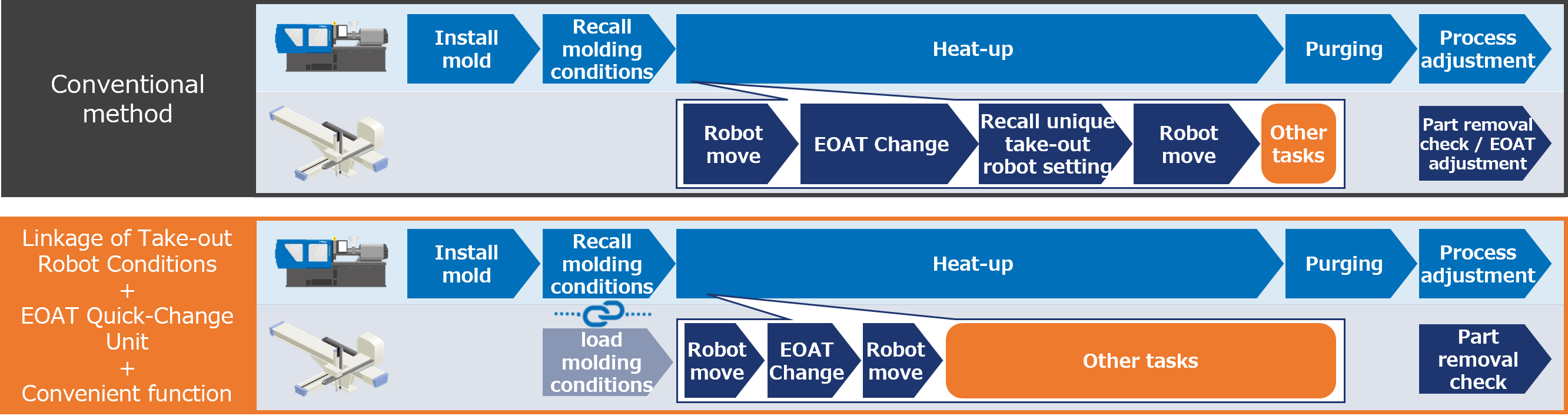
With conventional changeover operations, operators were required to manually replace EOAT and recalling unique take-out robot settings, and additional time was often needed for adjustment.
By combining the Linkage of Take-out Robot Conditions, the EOAT Quick-Change Unit, and convenient function, recalling unique take-out robot setting becomes unnecessary and the time required for EOAT replacement can be significantly reduced.
The time saved can be allocated to other tasks, improving overall production efficiency.
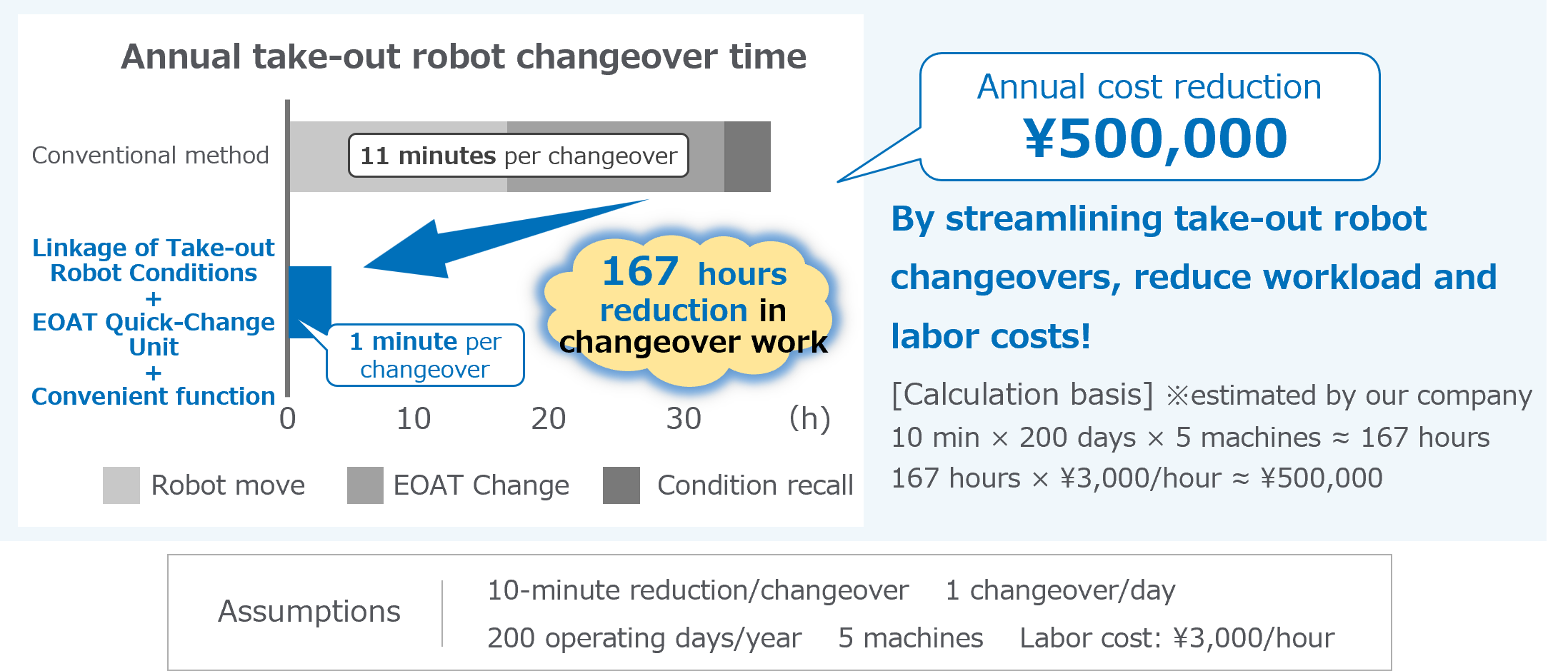
A changeover process that previously required approximately 11 minutes can be completed in about 1 minute, resulting in a reduction of approximately 10 minutes per setup. Assuming one changeover per day, 200 operating days per year, and five machines under management, this translates to approximately 167 hours of labor savings annually.
Based on a labor cost of ¥3,000 per hour, the annual labor cost reduction is estimated at approximately ¥500,000.
Reduced Repair Costs Caused by Human Error
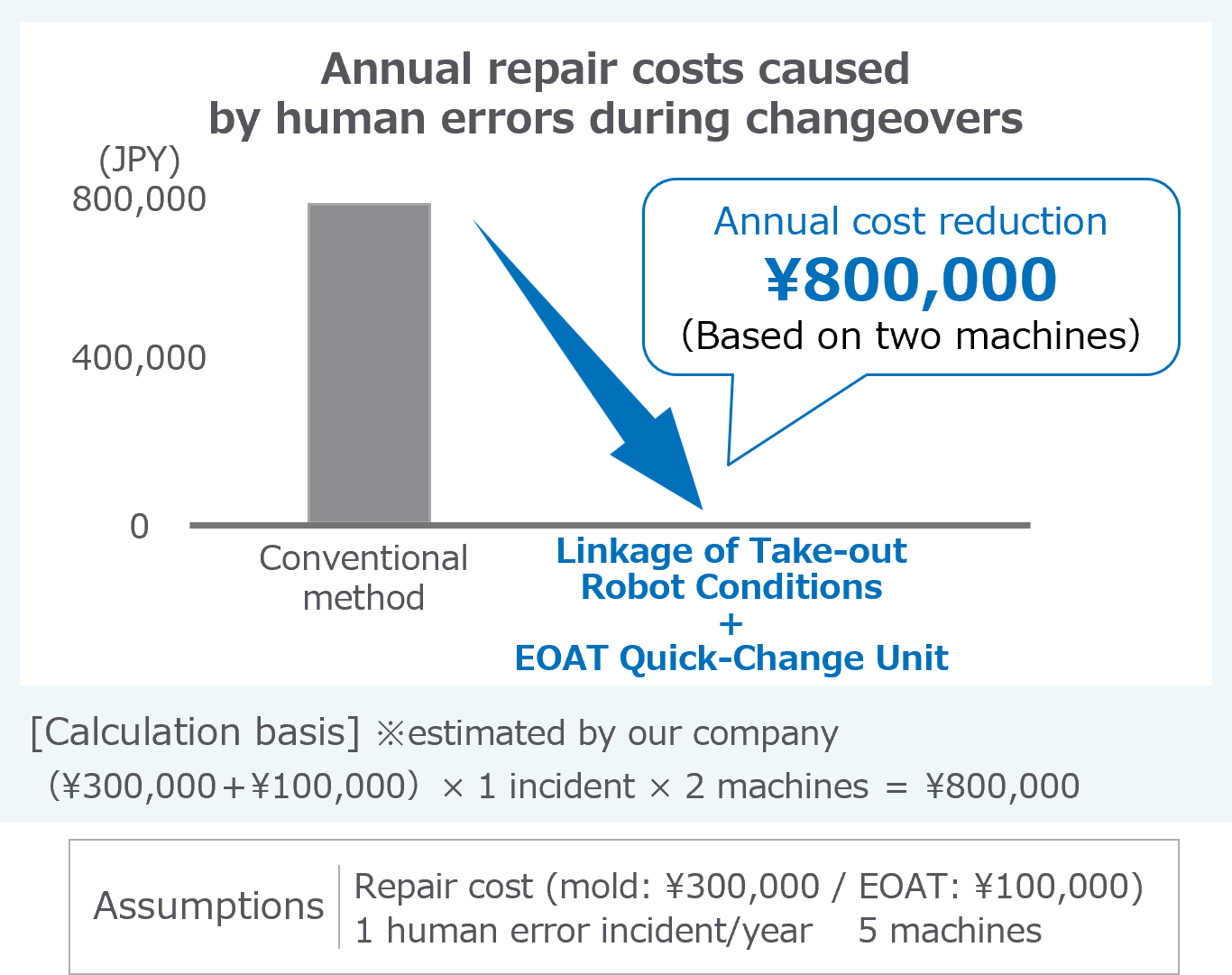
Human errors during setup, such as missed settings, incorrect settings, or forgotten EOAT replacements, can lead to damage to molds and EOAT, resulting in considerable repair costs. For example, if repair costs amount to approximately ¥400,000 per incident and one such incident occurs annually on two of five managed machines, the resulting loss would be approximately ¥800,000 per year.
By preventing these issues before they occur, substantial cost savings can be achieved.
Combining labor savings and repair cost reductions, annual cost savings of approximately ¥1.3 million can be expected.
Although the time required for each setup step is relatively short, productivity can vary significantly depending on whether appropriate measures are in place.
Today, an increasing number of functions are available that reduce dependence on operator experience and attention by supporting setup operations through system-based controls.
Why not take a step toward reducing dependency on individual operators while maintaining stable startups and consistent production quality?
The functions introduced in this article can be experienced firsthand at the Popular Features Demonstration held at the Chiba Technology Center.
Please feel free to contact us for more information.
▶ Popular Features Demonstration for Injection Molding Machines: Information and Registration
If you would like to see actual operation screens and learn more about the Linkage of Take-out Robot Conditions introduced in this article, please refer to the related article.
*The Linkage of Take-out Robot Conditions is an optional feature.
Contact us
For any questions regarding this article, please contact ushere.