At the Popular Features Demonstration held at the Chiba Technology Center, we showcase functions that help achieve energy savings, labor savings, and workforce reduction through live demonstrations using actual machines.
In this article, we introduce one of the solutions that attracted particularly strong interest from visitors: the integration of injection molding machines and peripheral equipment.
Machine Connectivity Is No Longer Something Special
In recent years, manufacturing sites have increasingly introduced machine connectivity and information sharing initiatives to address labor shortages and improve productivity. With the growing adoption of standardized communication protocols such as OPC UA, connecting equipment has become far easier than it was in the past.
At our Popular Features Demonstration, many visitors express strong interest in machine connectivity. However, we also hear comments such as, "How will connecting equipment actually change daily operations?" and "What specific benefits can be achieved?" Many users still find it difficult to visualize the practical advantages.
In this article, we introduce an example of connectivity between MATSUI MFG. CO., LTD.'s MC6 Series Mold Temperature Controller and our injection molding machine, and explain how machine connectivity can improve operational efficiency while helping prevent human errors.
Is Having to "Go Check the Temperature Controller" Becoming a Burden?
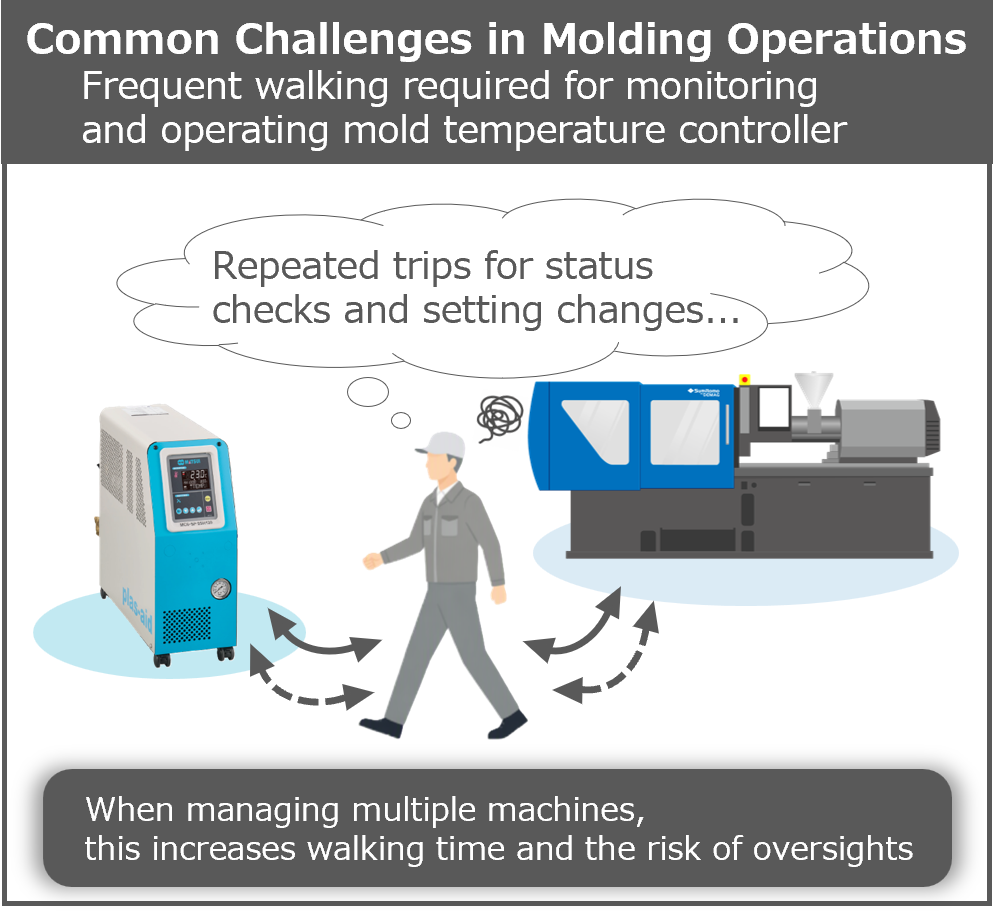
In molding operations, operators often move back and forth between the injection molding machine and the mold temperature controller during changeovers and production monitoring.
The mold temperature controller plays a critical role in controlling mold temperature. Operators must regularly check operating status, set temperatures, actual temperatures, and alarm information when abnormalities occur. However, each of these checks typically requires physically going to the controller. In facilities managing multiple machines, this can become a significant burden.
In addition, these frequent movements and confirmation tasks increase the risk of human errors, such as forgetting to change settings or forgetting to start the mold temperature controller. Even when molding conditions are switched correctly, leaving the mold temperature controller on previous settings or failing to start it can result in defective products and longer startup times.
One effective solution for reducing these workloads and often-overlooked losses is connectivity between the injection molding machine and mold temperature controller through OPC UA communication.
How Machine Connectivity Changes Shop Floor Operations
MATSUI's MC6 Series Mold Temperature Controller can be connected to our injection molding machines via OPC UA.
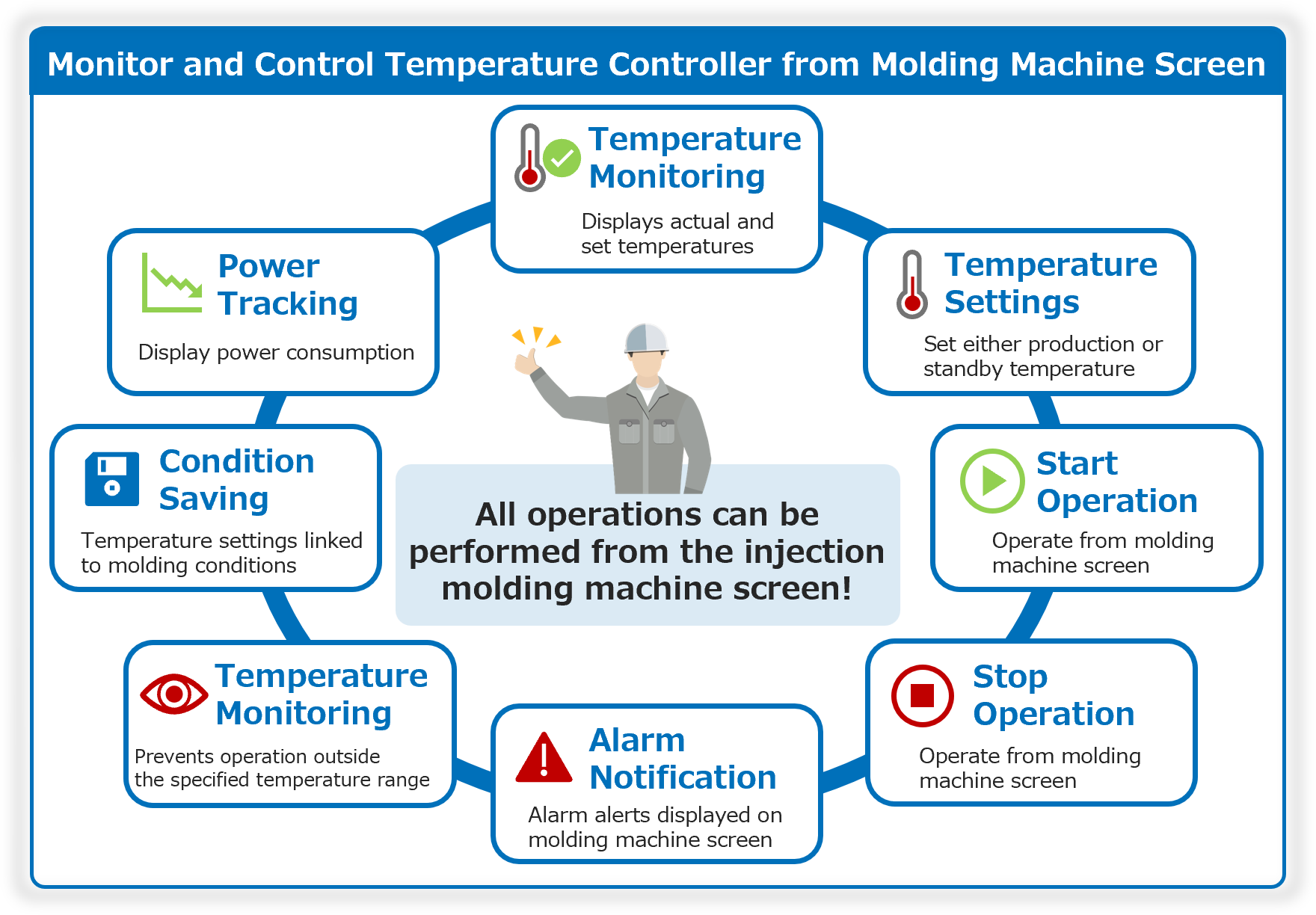
With this connection, information such as operating status, set temperature, actual temperature, and alarm status can be monitored centrally from the injection molding machine screen. Operators can check equipment status, modify temperature settings, and start or stop operation directly from the molding machine interface without having to walk to the mold temperature controller. When an abnormality occurs, alarm information is also displayed on the molding machine screen, allowing operators to quickly identify the issue and take corrective action.
Even when the mold temperature controller is installed in locations with limited accessibility, such as beneath the clamping unit, operators can still monitor and operate it from the molding machine screen. This not only reduces workload but also improves layout flexibility and space efficiency.
In addition, the monitoring function on the injection molding machine helps prevent operators from forgetting to start the mold temperature controller. If the controller has not reached the specified temperature range, the molding machine cannot transition to fully automatic or semi-automatic operation, reducing the risk of starting production without proper temperature control.
The mold temperature controller setpoints can also be linked to molding conditions. When molding conditions are recalled, the corresponding temperature controller settings are automatically applied. This helps prevent human errors such as forgotten setting changes during mold changeovers.
Furthermore, displaying power consumption data from the mold temperature controller on the molding machine screen makes it easier to monitor the energy usage of the entire molding cell, supporting energy-saving initiatives and operational improvements.
Equipment connectivity itself is not a new concept and has long been achieved through various communication methods. What makes OPC UA particularly valuable is its ability to transform equipment information into standardized data that can be utilized beyond simple monitoring and control.
In the plastics molding industry, standardization based on EUROMAP specifications continues to advance, enabling smooth data exchange between equipment from different manufacturers. This creates opportunities not only for connectivity between molding machines and peripheral equipment, but also for broader system integration involving MES platforms, robots, and other factory equipment.
In this way, OPC UA helps eliminate unnecessary tasks such as walking to or operating the mold temperature controller while also laying the foundation for future system integration and data utilization.
Benefits of Implementing OPC UA Communication
Reduced Time Spent Walking Between Machines
By connecting the injection molding machine and mold temperature controller via OPC UA, operators can monitor and operate the controller directly from the molding machine, eliminating unnecessary movement between equipment.
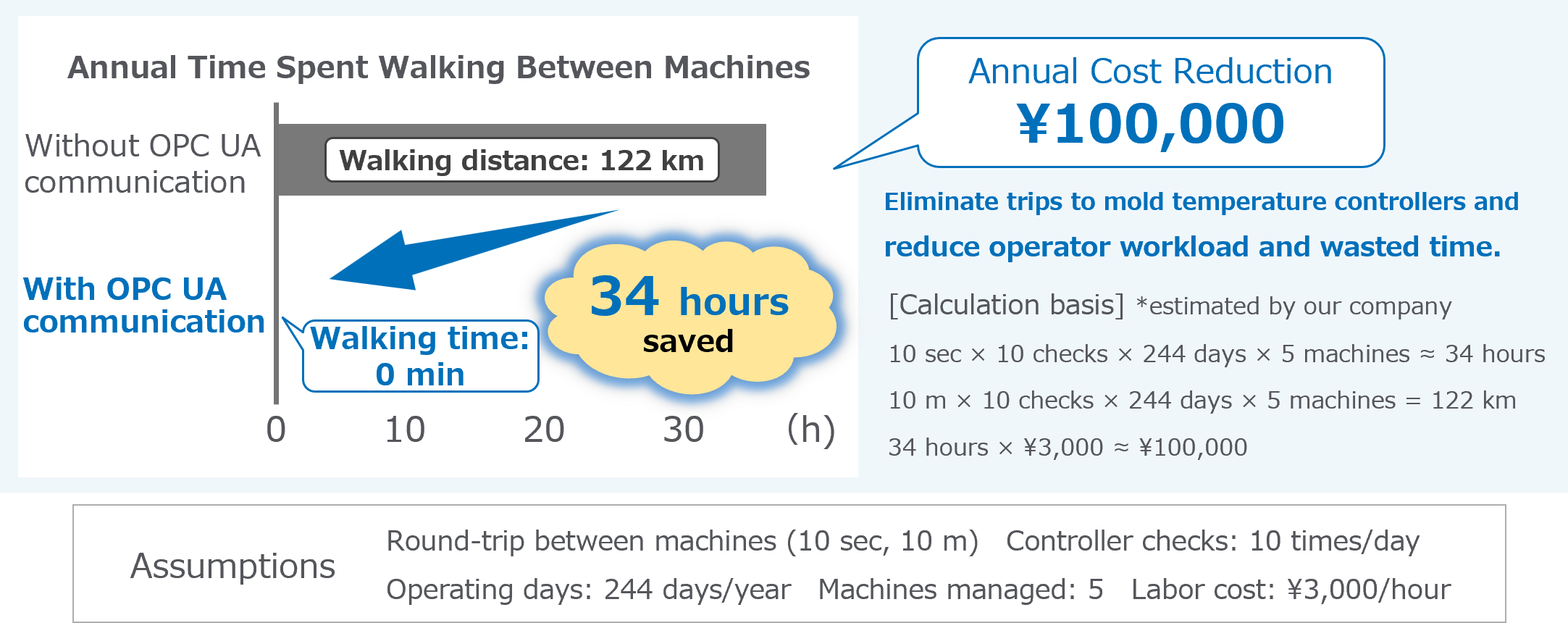
Based on our internal estimates, assuming ten status checks per day per machine and a round-trip distance of 10 meters between the molding machine and mold temperature controller, an operator travels approximately 100 meters per day. When calculated for five machines operating 244 days per year, this amounts to approximately 122 km of travel and 34 hours spent simply walking to monitor and operate the mold temperature controller.
Assuming labor costs of ¥3,000 per hour, this corresponds to approximately ¥100,000 per year.
While checking and operating a mold temperature controller is necessary, the act of walking between machines does not directly improve product quality. By enabling monitoring and operation from the injection molding machine screen, these non-value-added activities can be reduced, allowing operators to focus more on higher-value tasks such as setup improvement and quality management.
Reduced Losses Through Human Error Prevention
Linking molding conditions with mold temperature controller settings helps prevent forgotten setting changes and configuration errors, reducing losses caused by defective products and machine restart operations.
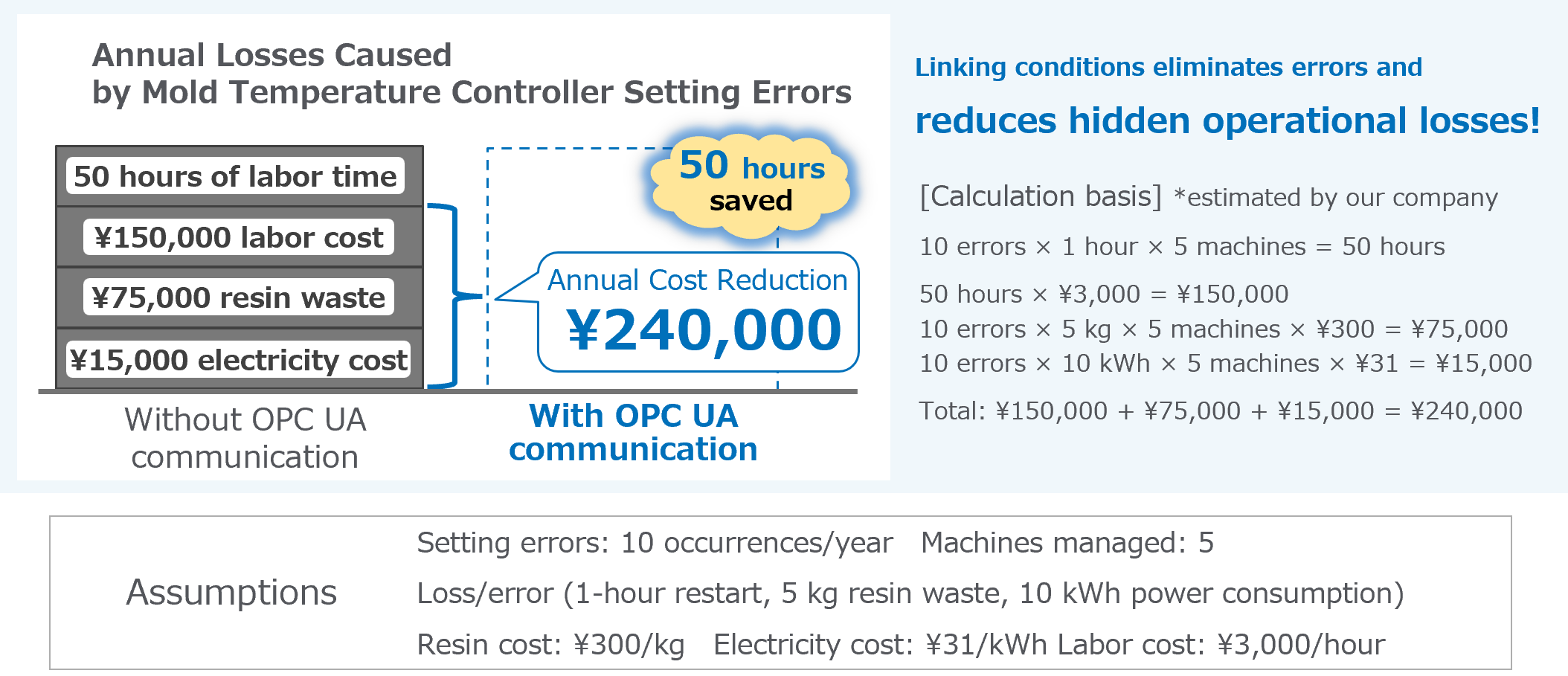
Based on our internal estimates, if each machine experiences ten setting errors per year and one hour is required for restart and recovery after each incident, five machines would generate approximately 50 hours of additional work annually.
At a labor cost of ¥3,000 per hour, this represents approximately ¥150,000 in annual losses.
In addition, the impact of setting errors is not limited to labor time. Restart operations also generate resin waste and unnecessary energy consumption.
Although a single setting error may seem minor, it creates hidden losses in labor, material consumption, and energy use. Preventing these errors through machine connectivity contributes not only to stable product quality but also to reducing waste throughout the manufacturing process.
Looking Beyond Equipment Connectivity
The functions introduced in this article primarily focus on operational improvements through the utilization of temperature and power consumption data. However, OPC UA is an open communication standard that is not tied to any specific manufacturer. As a result, it can be used not only for mold temperature controllers but also for connecting other peripheral equipment and exchanging data with higher-level systems such as MES platforms.
Connectivity between injection molding machines and mold temperature controllers represents the first step toward realizing a smart factory. By connecting equipment and utilizing the data generated from it, manufacturers can build more efficient and sustainable production environments.
Why not start by rethinking everyday tasks such as walking to monitor or operate a mold temperature controller and take the first step toward machine connectivity?
Expanding Collaboration Between MATSUI and Sumitomo Heavy Industries
MATSUI and our Chiba Technology Center are currently advancing new initiatives utilizing sensing technologies.
If temperature, flow rate, pressure, and other equipment conditions can be monitored in greater detail, accumulated data may eventually be used for predictive maintenance, anomaly detection, and AI-driven productivity improvements.
If you are considering how these technologies could help solve challenges in your own production environment, or if you are interested in these initiatives, please feel free to contact us.
The functions introduced in this article can be experienced firsthand in the Popular Features Demonstration held at our Chiba Technology Center.
Please feel free to contact us for more information.
▶ Popular Features Demonstration for Injection Molding Machines: Information and Registration
*To utilize OPC UA communication between the injection molding machine and mold temperature controller, both devices must support EUROMAP 82.1 (OPC UA communication functionality). This feature is available as an option on both systems.
Contact us
For any questions regarding this article, please contact ushere.