*This article is an English translation based on the original Japanese version.
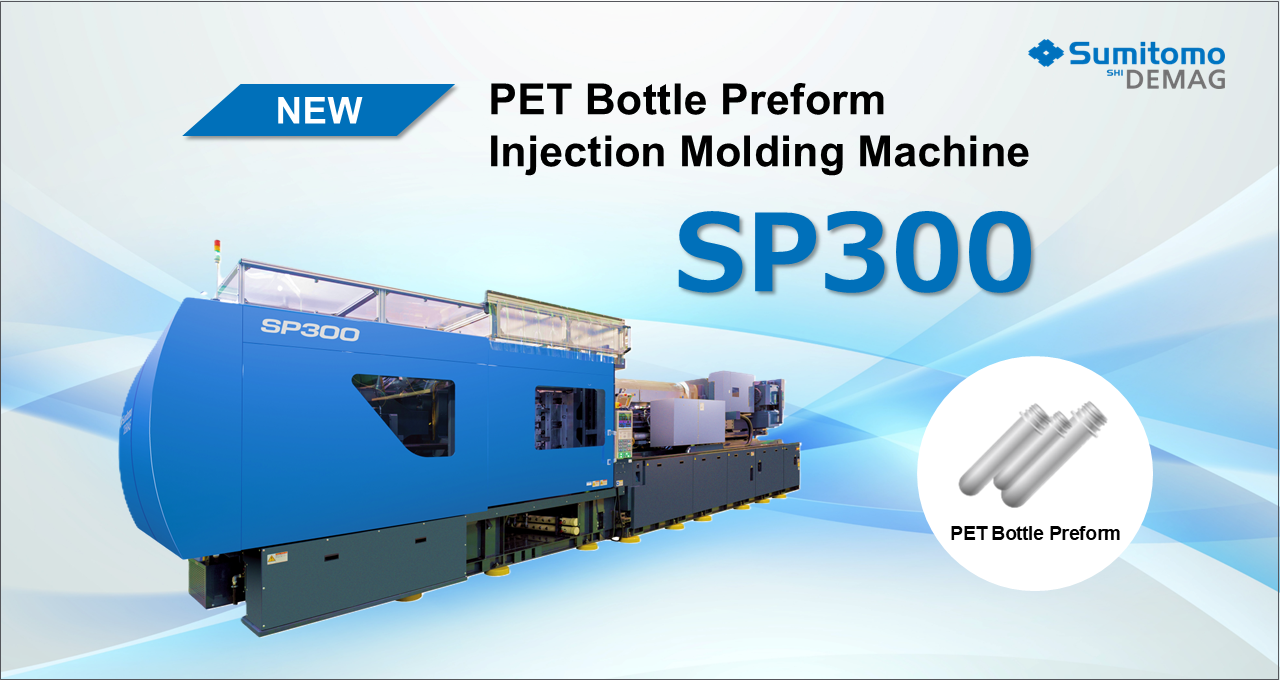
We have released "SP300", a PET bottle preform injection molding machine.
Before introducing this new model in detail, we would like to briefly look back on SHI's long-standing commitment to PET preform molding technology.
SHI's Approach to PET Bottle Preform Injection Molding Machines
We began delivering PET bottle preform injection molding machines in 1997. This year marked a major turning point in Japan, as the enforcement of the Container and Packaging Recycling Act established systems for waste separation and recycling, triggering rapid growth of the small-size PET bottle market.
Applying technologies cultivated through our standard injection molding machines to PET preform molding, we advanced the development of dedicated machines. Since then, we have supported customers manufacturing PET bottles of various sizes and shapes, providing both technical expertise and comprehensive support.
As a result, total shipments have now exceeded 100 units. This track record, built steadily over more than a quarter century, represents one of our greatest strengths.
Currently, our lineup includes two models:
- SP500E, a screw pre‑plasticizing type machine that supports molds with 96 to 144 cavities, and
- SE‑EV‑S‑HD PET specification, an in‑line screw type machine supporting 24 to 48 cavities.
In response to growing demand for medium‑scale production, we have expanded our lineup by adding SP300, which adopts a screw pre‑plasticizing system and supports 48 to 72 cavities.
Key Features of New "SP300"
1. Molding Stability Supported by a Long Track Record
SP300 inherits molding stability technologies proven over many years, including the double center press platens and clamping force feedback control, both of which are also used in our flagship precision molding machine SE‑EV‑S. In addition, SP300 employs the same PET‑dedicated screw used in the higher‑productivity SP500E, as well as a high‑precision electric ejector, further optimizing performance for PET preform molding.
- Double Center Press Platens
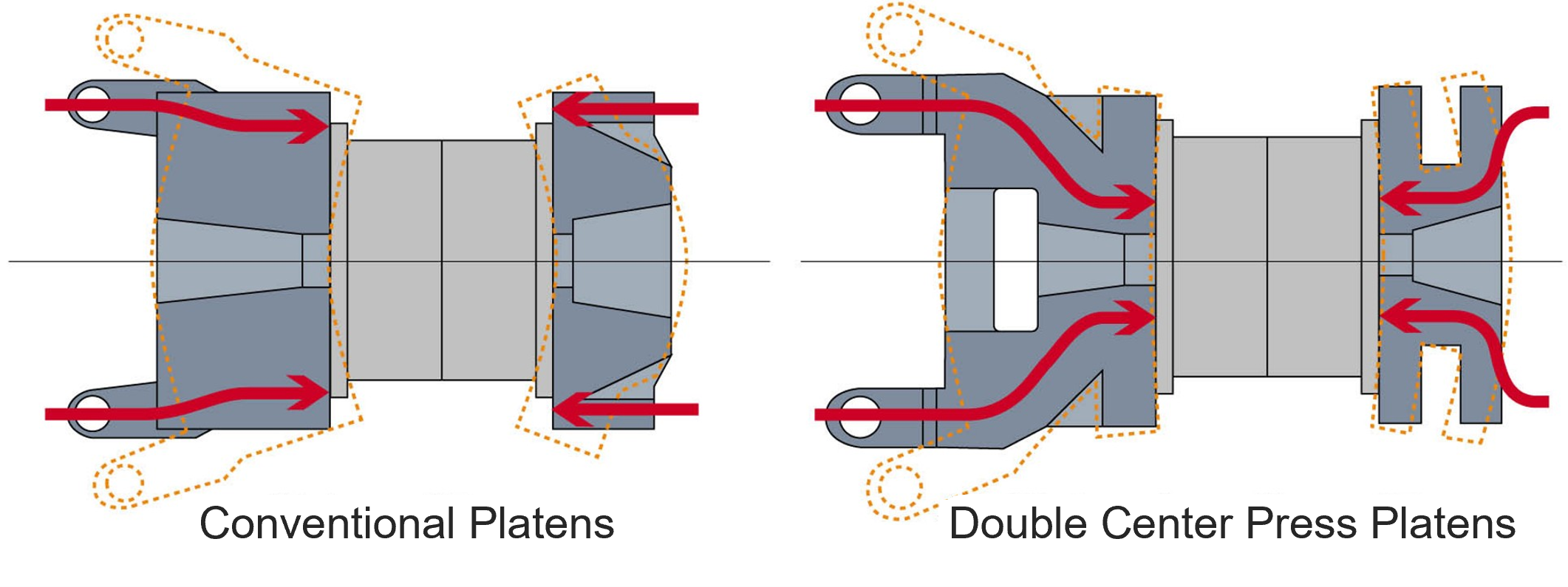
With conventional toggle clamping mechanisms, clamping force tends to concentrate at the four corners of the mold, making it difficult to distribute pressure evenly and increasing the risk of flash, especially around the mold center.
The double center press platens feature a platen design that efficiently transmits force toward the center of the mold, suppressing variations in surface pressure distribution.
As shown in the figure below, pressure‑sensitive film was used to measure surface pressure when the mold was closed. Areas under high pressure appear in red, low pressure areas in blue, and areas without load in white.
While the conventional platens (left) show low pressure at the center, the double center press platens (right) demonstrate a uniform pressure distribution across the entire mold surface.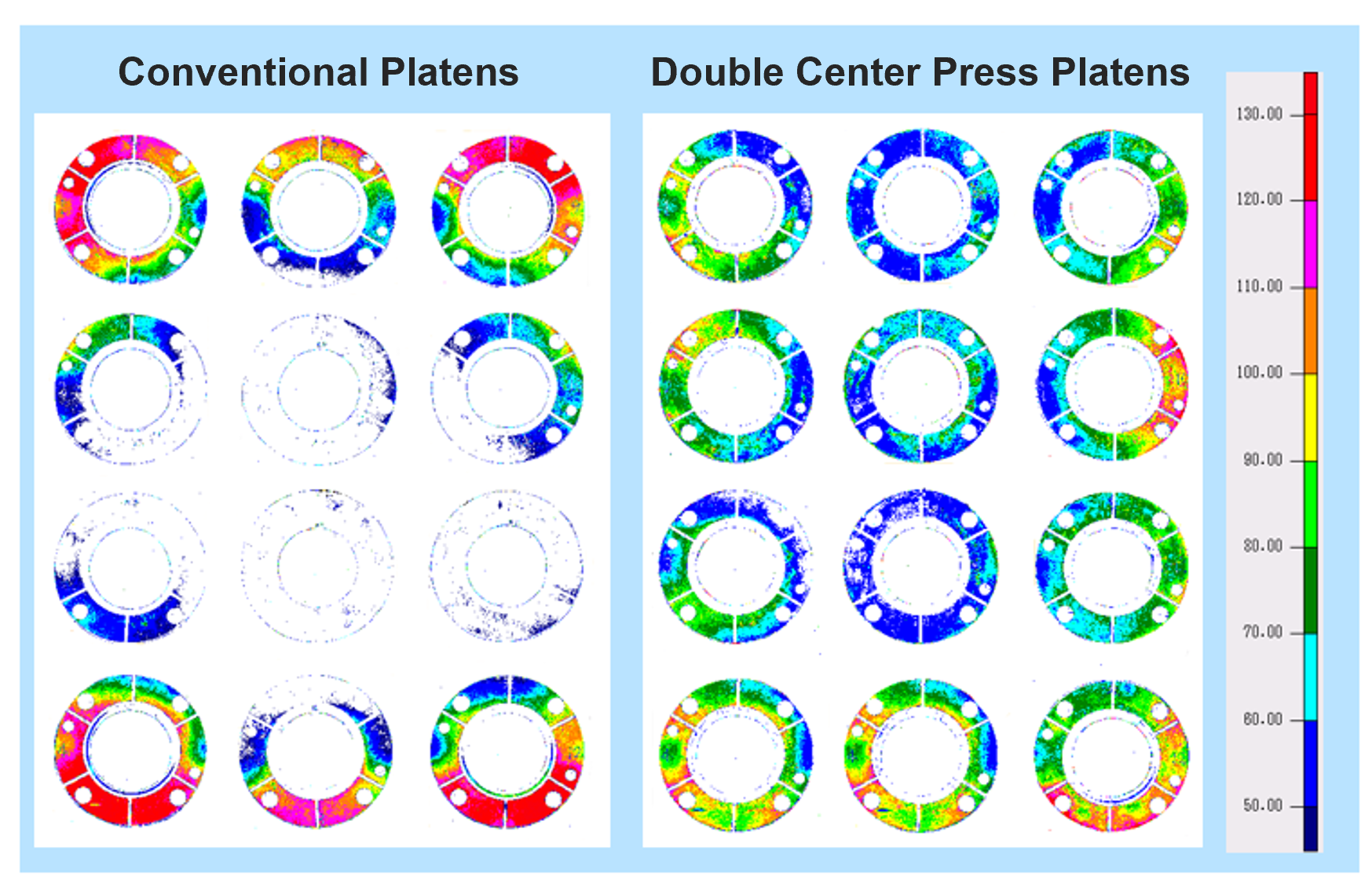 *Measured using pressure‑sensitive film with a 12‑cavity container mold.
- Clamping Force Feedback Control
During continuous mass production, mold temperature gradually increases. Thermal expansion causes the actual clamping force to rise beyond the set value, which can lead to issues such as short shots or gas burning.
[ Actual Clamp Force Transition in Mass Production ]
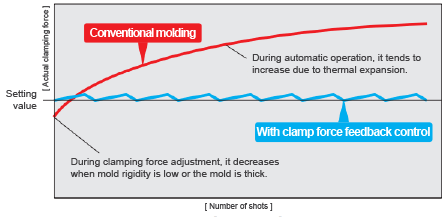
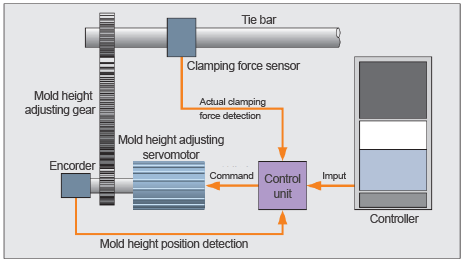
To address this, most SHI injection molding machines are equipped with clamping force sensors on the tie bars, continuously monitoring actual clamping force. Based on the detected values, mold thickness is automatically adjusted, maintaining the preset clamping force.
[ System Configuration of Mold Clamping Force Feedback Control ]
Next, we introduce two technologies specifically optimized for PET preform molding.
- PET‑Dedicated Screw
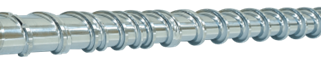
This screw was developed to address both high‑cycle operation and insufficient mixing, key challenges in PET molding. Its low‑shear screw design ensures a stable resin flow rate, while integrated mixing elements and sub‑flights enable uniform melting. This allows recycled PET resin to be molded under conditions close to those used for virgin materials, a capability increasingly important in today's market.
- High‑Precision Electric Ejector
The ejector adopted a high‑durability ball screw to ensure stable ejection motion. High repeatability and smooth operation enable reliable transfer of molded products to the take‑out robot even during high‑cycle production.
Together, these technologies enable stable, high‑cycle molding performance even in environments requiring large‑scale production.
2. Electrification That Enhances Energy Efficiency
SP300 features a hybrid configuration combining hydraulic and electric drives, while still achieving higher energy‑saving performance compared with conventional hybrid machines.
The clamping unit employs an electric drive system that consumes energy only for required motions. For the injection unit, instead of continuously driving a pump as in conventional machines, a servo motor‑driven pump supplies pressure to the accumulator only at the required timing, enabling efficient operation.
SP300 is the first hydraulic or hybrid injection molding machine to adopt this servo motor‑driven pump system, making it one of SHI's core technologies driving energy efficiency.
3. Integrated, Japan‑Made System Proposals
We offer integrated system proposals that combine SP300 with dedicated take‑out robots manufactured in Japan. This reduces the workload required for equipment start‑up and enables a smooth start of production. For molds, we support locally sourced molds and are also prepared to propose Japan‑made dedicated molds manufactured by SHI, in accordance with customer requirements.
- Dedicated Take‑Out Robot "PZ‑2200," Co‑Developed with Star Seiki Co., Ltd.
PZ‑2200 is equipped with a water‑cooled take‑off plate and an internal preform cooling function. In conventional molding, products are fully cooled inside the mold before removal. With this system, however, preforms can be removed while still hot and cooled inside the take‑out robot, significantly shortening the molding cycle.
- Dedicated PET Mold "SP‑Evo Series"
The SP‑Evo Series is optimized to achieve both long‑term stable operation and high‑cycle molding in PET preform production. To suppress carbonization risk and weight variation caused by localized overheating, which are common challenges with PET resin, the number of temperature control zones in the hot runner manifold has been increased, ensuring more uniform temperature control. This mold supports extensive process settings that can flexibly accommodate multi‑product production.
Additionally, spiral cooling channels are adopted for thin‑wall, high‑cycle molding. Cooling efficiency is greatly improved through analysis‑based flow path design. Each new mold also undergoes a comprehensive structural review to enhance maintainability and improve ease of handling in long‑term continuous operation environments.
4. Reliable Support Even After Installation
SHI has local subsidiaries dedicated solely to the sales and support of injection molding machines. These teams provide prompt spare parts supply and dispatch service engineers from nearby locations. Highly experienced engineers are also available to consult on molding challenges. We hope customers will select SHI as a long‑term partner, backed by decades of proven experience, to support stable operation well beyond installation.
List of local subsidiaries: Click here
Contact Us
For detailed technical explanations, specifications, machine dimensions, or other inquiries, please feel free to contact us using the link below.
[ Contact ] IB & PET Sales Group, Sales Strategy Department