*This article is translated using machine translation. Please note that the accuracy of the translation is not guaranteed, and some proper nouns may not be translated correctly.
Chinaplas 2026 Held at the Largest Scale Ever
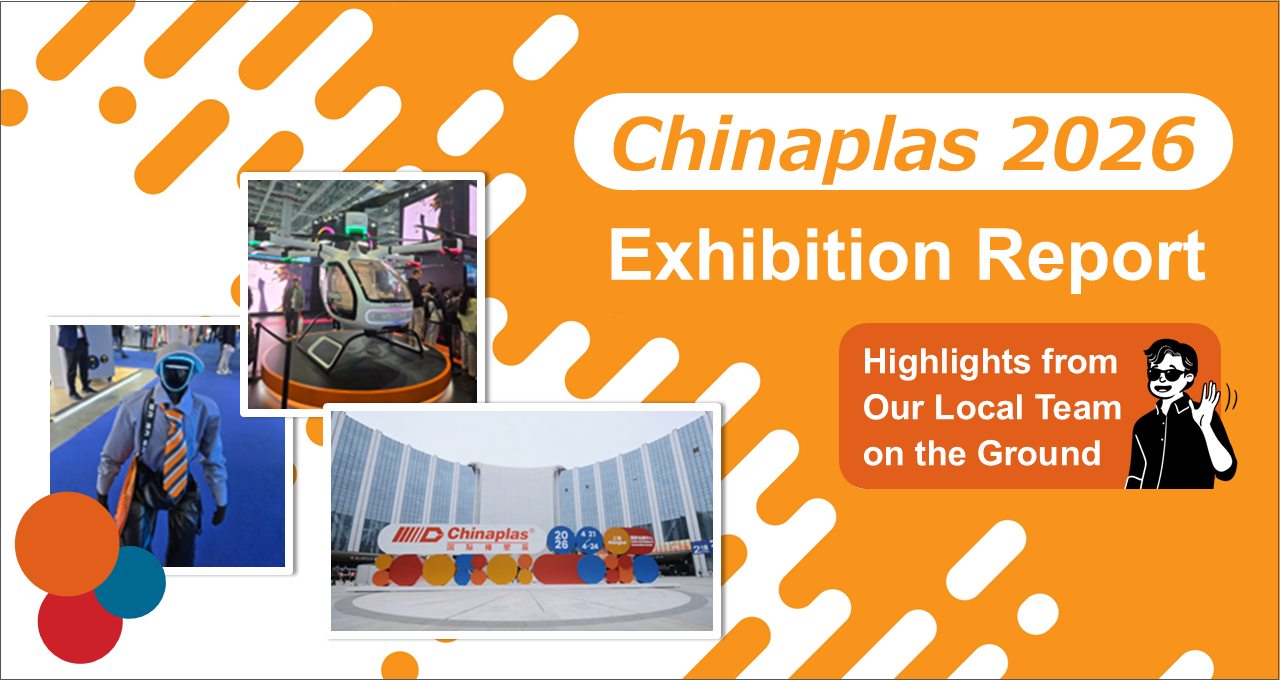
Chinaplas 2026 was held in Shanghai, China, over four days from April 21 to 24.
The theme of the event was "Transformation / Collaboration / Sustainability."
As the largest plastics and rubber exhibition in China, this event once again reached a record-breaking scale, hosting more than 5,000 exhibitors across 16 exhibition halls.
In this article, we share not only our exhibit highlights but also insights into market trends and technological developments in China, based on impressions gathered by our local staff as they walked around the venue.
The Energy and Atmosphere at the Venue
The total number of visitors over the four days reached 350,189, marking a 24% increase compared to the previous event held in Shenzhen.
The exhibition area covered 390,000 m²--equivalent to more than 52 soccer fields--but even more impressive was the sheer number of visitors filling the venue. Many attendees came from overseas, and a variety of languages could be heard throughout the venue--not only Chinese and English--creating a lively atmosphere throughout the day.
Key Focus Areas Observed in the Exhibitions
Emerging Industries
One of the most striking aspects of this year's Chinaplas was the large number of exhibits targeting emerging industries. While displays related to electric vehicles and AI data centers continued to be prominent, even more noticeable were the following fields:
- Humanoid robots
- Flying cars driven by the "low-altitude economy"
The humanoid robot exhibits were particularly eye-catching. In the exhibition area, many visitors stopped to watch the robots' movements closely. When stopping to observe, one of the humanoid robots approached and even shook hands, which made for a memorable experience.
Rather than relying on catalogs or panels, exhibitors attracted attention by showing real machines and allowing visitors to experience them in operation. This is something that can truly be appreciated only by seeing it on-site.

Another highlight was the display of flying cars shaped like helicopters or airplanes. These were presented as a key element of the "low-altitude economy." While the term "low-altitude economy" may not yet be familiar in other countries, it has gained attention in recent years in China.
It refers to efforts to develop new industries based on the use of relatively low-altitude airspace for logistics and transportation, including drones and flying cars. Many exhibits at this exhibition reflected this trend.

Displays have shifted from the previously common teardown models of electric vehicles to presentations featuring humanoid robots and flying cars, making it easy to understand at a glance where these materials are used.
There were also noticeable changes in how companies expressed their themes. While expressions emphasizing "Transform" and "Move forward" had been dominant, this year keywords such as "Journey" and "Shape" stood out. Compared to previous expressions that focused on technological evolution and improvement, these appeared to place more emphasis on shaping a better future society.
Environmental Solutions
Environmental initiatives, which have been steadily advancing for some time, also remained a major focus, as evidenced by the presence of dedicated exhibition halls for recycling equipment. In addition to proposals involving PCR materials (recycled materials) and biodegradable resins, many exhibits in the packaging and container sectors featured technologies for reducing material usage, such as lightweighting through thinner structures.
Rather than being positioned as a headline attraction, environmental solutions appeared to be treated as a basic requirement that is taken for granted. Although less flashy, this area showed steady and continuous technological progress.
Exhibits Presented at Our Booth
Our overseas subsidiaries--Sumitomo (SHI) Plastics Machinery (Shanghai) Co., Ltd. and Demag Plastics Machinery (Ningbo) Co., Ltd.--exhibited under the theme "FOR A BETTER FUTURE TOGETHER."

At our booth, we conducted demonstrations of our latest AI functions currently under development. These functions automatically adjust molding conditions based on the quality results of molded products, allowing visitors to experience the difference between operations with and without AI. While many companies gave presentations on AI-related technologies, as far as we observed, our booth was the only one to offer live demonstrations, which attracted a great deal of attention.
In addition, we demonstrated the molding of yogurt cups based on high-cycle molding systems, which have strong compatibility with environmental and lightweighting needs. Many visitors stopped to observe the high level of precision achieved in these demonstrations.
We would like to express our sincere gratitude to everyone who visited our booth and to the partner companies who supported us.

Closing
Chinaplas 2026 was an exhibition that strongly conveyed both the present and the future of the Chinese and broader Asian markets, particularly through the focus on emerging industries. We will leverage the technologies and market trends observed at the venue in our future product and solution proposals.
Contact us
For any questions regarding this article, please contact us here.