In injection molding, clamping force is a critical factor that directly influences molding quality.
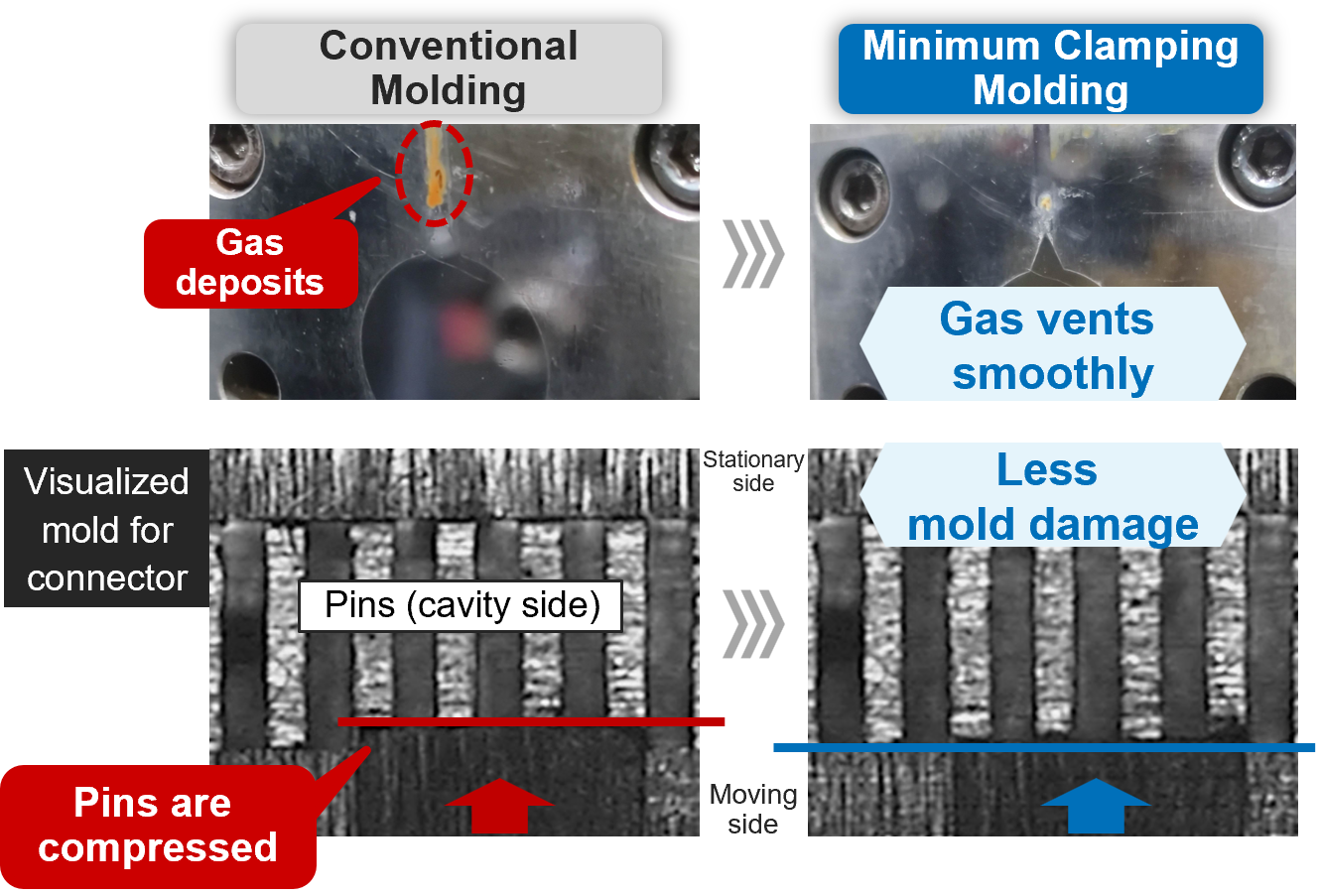
Excessive clamping force restricts gas venting and causes various troubles. Molding with lower clamping force improves gas ventilation, contributes to a higher yield rate, extended mold service life, and energy savings.
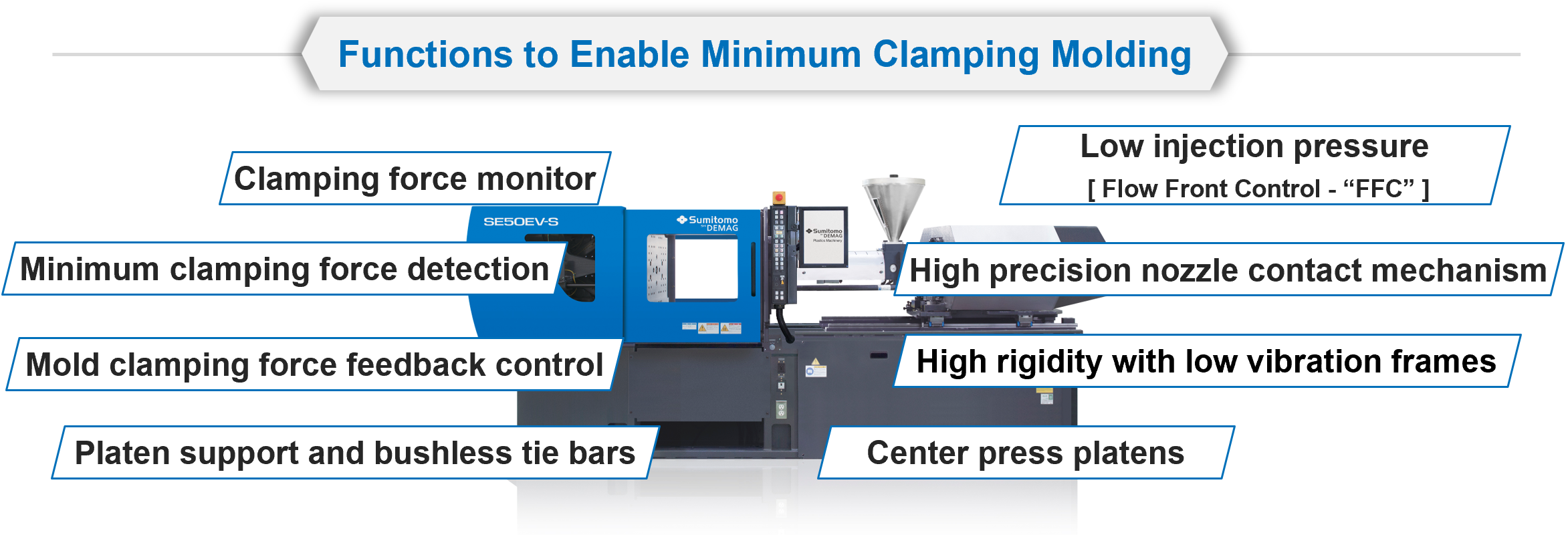
Our injection molding machines are equipped with a wide range of functions to realize Minimum Clamping Molding (MCM).
Even though many customers recognize the benefits of low clamping force molding, we often hear concerns like "How far can the clamping force be reduced?" "It is difficult to judge whether the clamping force is excessive." "There is concern that defects may occur, making it difficult to try."
To address these concerns, we have newly added an assistance function, "MCM Guidance," to support adjustment to the optimum clamping force.
Impact of Excessive Clamping Force
To prevent defects such as flash, clamping force is sometimes set higher than necessary. However, excessive clamping force may cause the following problems:
- Gas venting is restricted, leading to the accumulation of gas deposits
- Gas burn and short shots occur, increasing mold maintenance frequency
- Mold deformation and wear progress, shortening mold service life
- Power consumption increases, resulting in higher operating costs
Features and Effects of Our Molding Machines that Enable Low Clamping Force Molding
Low clamping force molding is the solution to these challenges.
Our injection molding machines incorporate various mechanisms and functions that contribute to stable Minimum Clamping Molding:
Mechanisms supporting low clamping force:
platen support, center press platens, high-rigidity, low-vibration frames
Functions to maintain low clamping force:
low injection pressure control (Flow Front Control - FFC) and mold clamping force feedback control
Functions to optimize clamping force:
clamping force monitor and minimum clamping force detection
Molding with the minimum required clamping force promotes gas ventilation, preventing short shots and gas burns, which also minimizes mold deposits and mitigates damage such as mold deformation and pin breakage.
Easy Adjustment with the New "MCM Guidance"
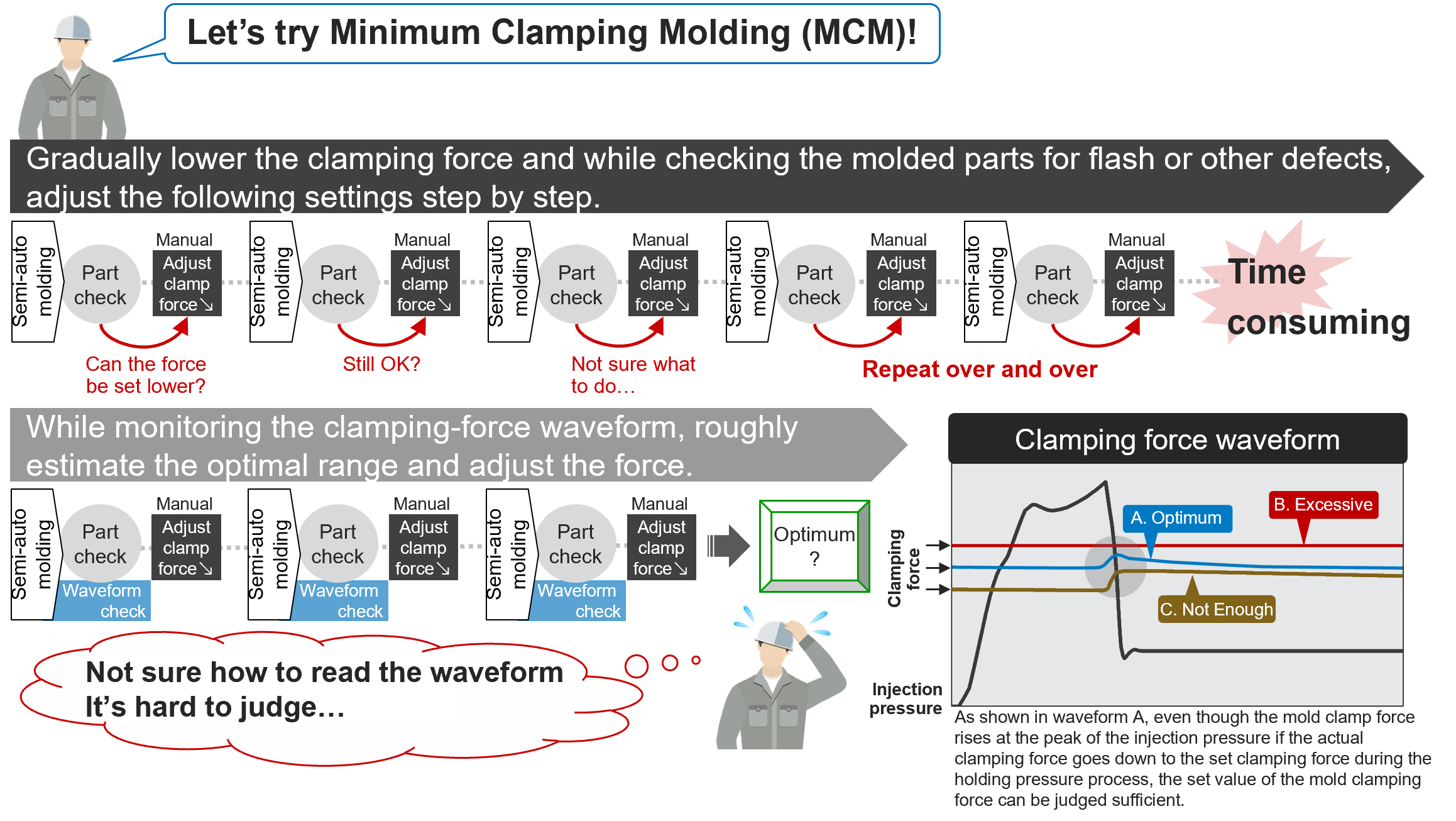
Adjusting clamping force has traditionally depended heavily on operator skill, making it difficult for less experienced operators to lower clamping force settings.
Although checking the clamping force waveform will be useful for proper judgment, this requires specialized knowledge and experience. Without waveform analysis, operators need to adjust settings by trial and error while checking molded parts, which is time-consuming and stressful.
MCM Guidance assists this process by automatically reducing the clamping force step by step and judging the optimum value.
No waveform analysis is required--the injection molding machine automatically determines whether the clamping force is appropriate.
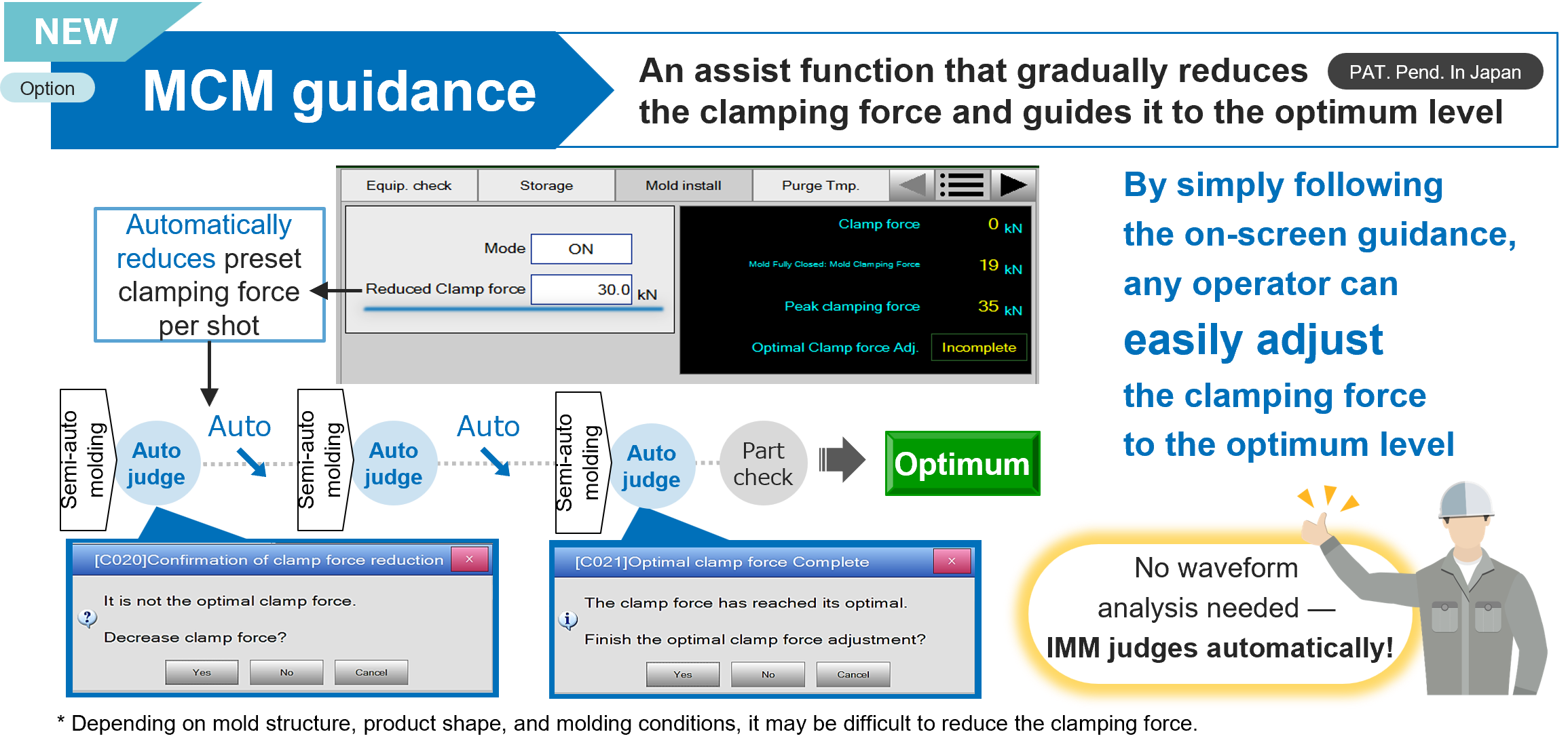
This enables any operator to easily adjust the clamping force to the optimum level.
Lowering the clamping force also reduces power consumption, contributing to energy savings.
MCM Guidance helps eliminate dependence on individual skill of adjusting clamping force and supports stable and efficient production.
*MCM Guidance is an optional feature.
Contact us
For any questions regarding this article, please contact ushere.