At the "Popular Feature Demonstration" held at the Chiba Technology Center, visitors can experience a variety of features that achieve energy savings, labor savings, and manpower efficiency through demonstrations using actual machines.
Among these, we introduce initiatives related to injection molding machines and peripheral equipment that have attracted particularly high interest from customers.
In recent years, as quality requirements in molding operations have become more demanding, interest in quality control using external sensors, including cavity pressure sensors, has been growing. At the same time, there are many cases where the data collected from these sensors is not being fully utilized.
In this article, we explain the importance of "sensing" to visualize conditions inside the mold as data, and introduce a solution that combines cavity pressure sensors from Futaba Corporation with our Quality Control Package to support quality improvement and defect analysis.
Understanding What Is Happening Inside the Mold
In injection molding, many phenomena cannot be identified solely from information obtained from the molding machine, such as injection pressure, dosing time, and screw position.
For example, when defects such as frequent flashes or short shots occur, or when product weight varies, what we really want to know is: "What was happening inside the mold?"
However, it is not possible to directly observe conditions inside the mold. In other words, the mold is a black box.
For this reason, in recent years, the use of sensors to measure resin pressure, resin temperature, mold temperature, mold cooling water flow rate, and other parameters has been expanding as a way to understand conditions inside the mold through data.
By utilizing this sensor data, changes in molding conditions that were previously difficult to assess based on experience and intuition alone can now be quantified.
Cavity Pressure Sensing to Support Quality Control | Futaba Corporation
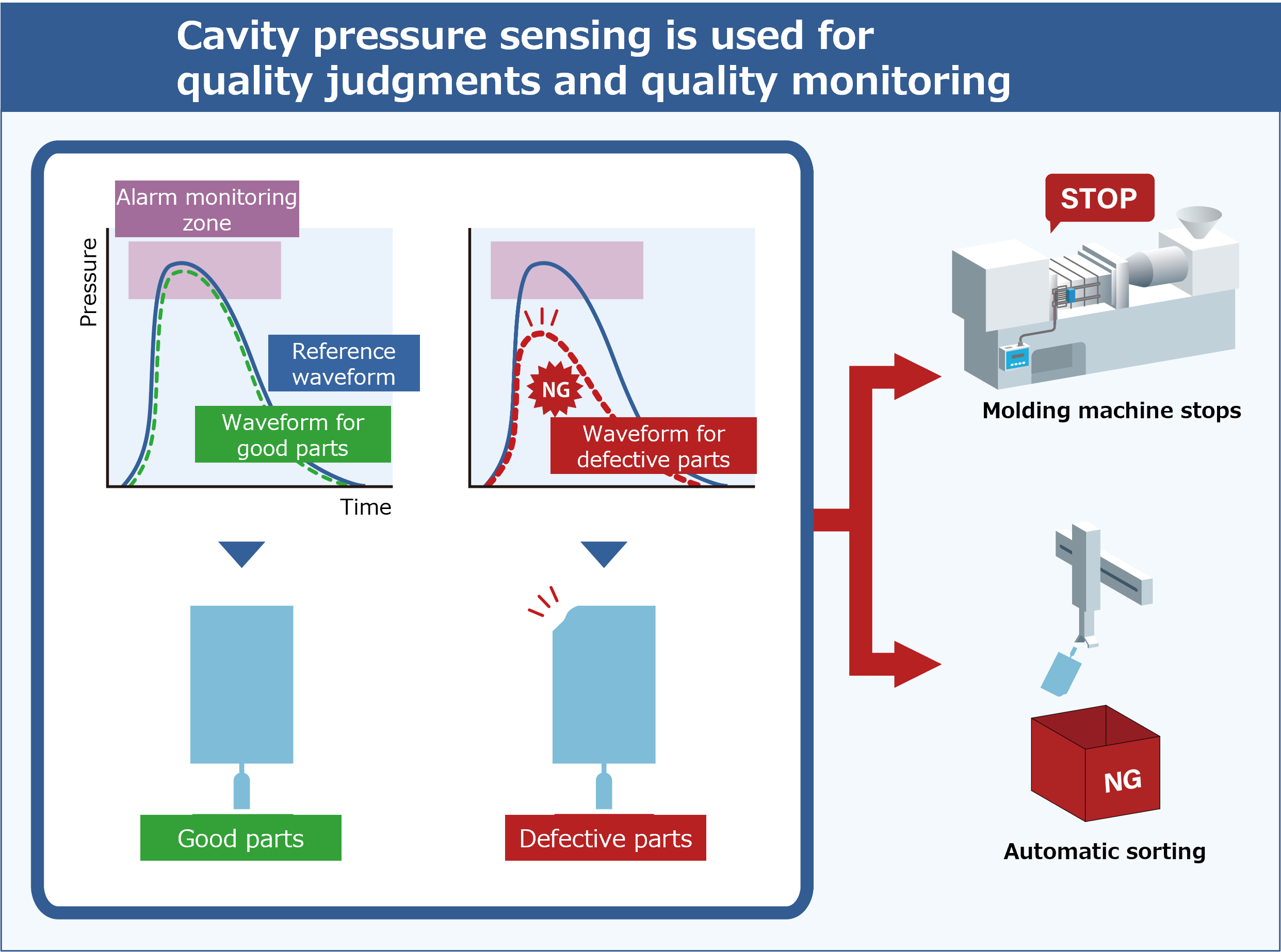
Among various types of sensing, cavity pressure is widely used as data that has a high correlation with product quality. By installing a cavity pressure sensor at the final point where the molded product is formed and measuring the resin pressure inside the mold, it is possible to detect changes related to product quality, including flashes, short shots, variations between cavities, and shot-to-shot variations.
For this reason, cavity pressure data is used not only for defect analysis, but also as important data supporting quality control, including pass/fail judgment and quality monitoring.
At the same time, although cavity pressure sensing is used during product development and prototyping, cost and ease of installation can become challenges when operating it continuously in mass-production processes.
Futaba Corporation offers cavity pressure sensors suited to different mold structures and installation conditions, including ejector-pin and button-type sensors. Some types can be used as replacements for existing ejector pins, allowing installation in some cases while minimizing modifications to the mold.
This makes it possible to introduce cavity pressure sensing in stages according to needs such as:
- Starting cavity pressure sensing for the first time
- Introducing it initially for selected molds
- Using it not only for development but also in mass-production processes
In actual production environments for products that require high quality stability and dimensional accuracy, such as automotive parts and medical-related parts, cavity pressure sensing is used not only during development but also for quality monitoring in mass-production processes. In addition, depending on the purpose of quality control and the required level of control, sensing data such as resin temperature and mold temperature can also be utilized in addition to cavity pressure.
Sensor Data Is Being Collected, but Is Not Always Fully Utilized
External sensors, including cavity pressure sensors, have made it possible to understand conditions inside the mold that were invisible.
However, simply collecting data does not lead to quality improvement.
In actual production environments, the following challenges are not uncommon:
- Because sensor data and molding machine data are managed in separate systems, multiple screens and CSV files must be cross-checked each time an analysis is performed, making root-cause investigation time-consuming.
- Sensor data is collected, but is checked only when a defect occurs and is not utilized for routine quality monitoring.
- Even when users want to compare waveforms for good and defective products, differences in data storage locations and formats make comparison difficult.
- During quality audits or when responding to customer inquiries, molding machine data and sensor data must be searched for separately.
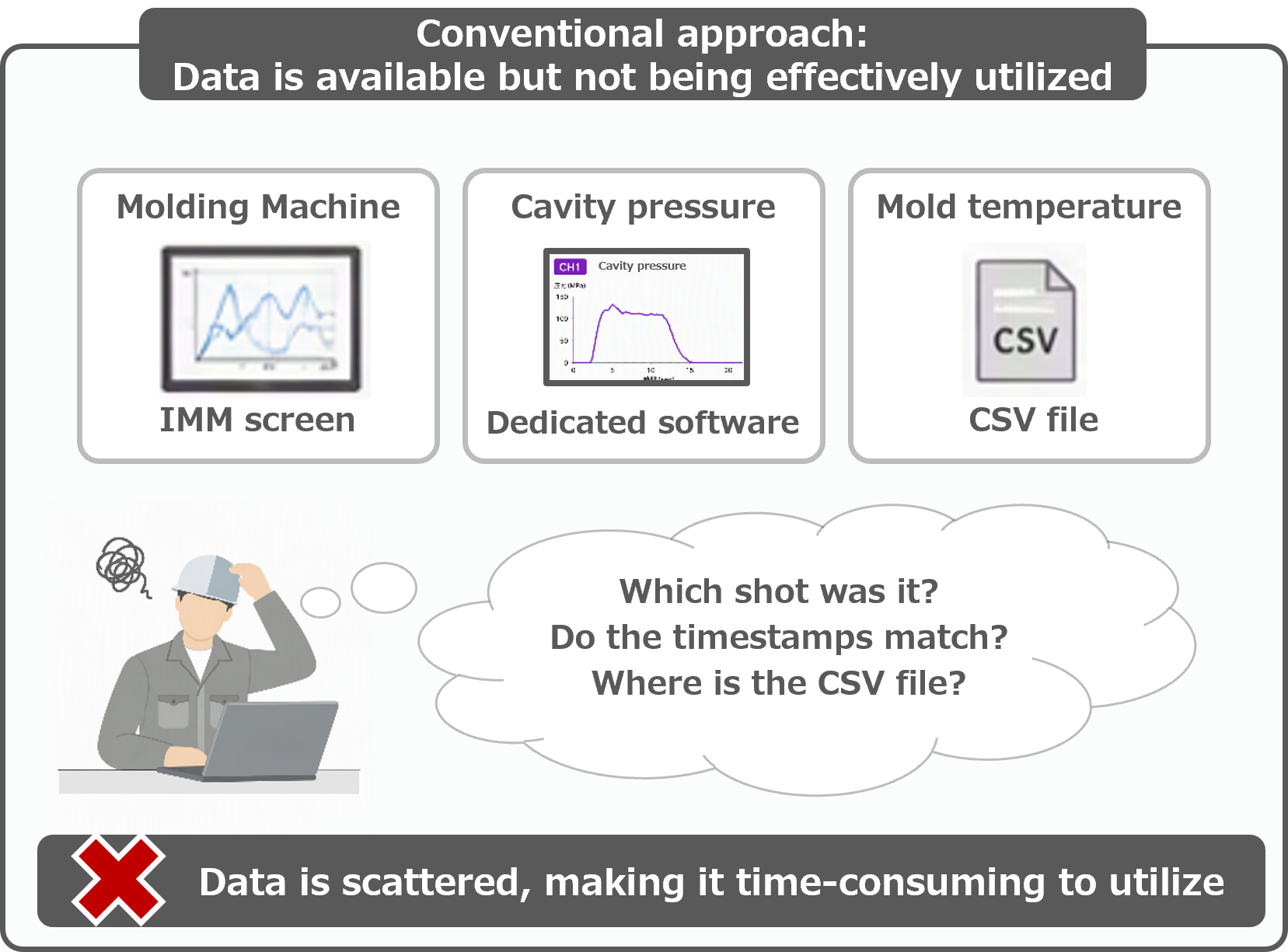
In other words, many production sites face the challenge that "data is being collected, but there is no system in place to use that data for quality improvement."
Even valuable sensor data cannot be fully utilized if it cannot be quickly accessed when needed or analyzed together with injection molding machine data.
- Quickly comparing differences between the waveforms of good and defective products
- Identifying signs of abnormalities from changes in sensor data
- Analyzing causes together with injection molding machine data
Being able to perform these tasks can help improve the efficiency of defect analysis, strengthen quality monitoring, and even automate quality records.
Our Quality Control Package provides a system for addressing these challenges and utilizing collected sensor data for quality improvement.
Centralized Data Management with the Quality Control Package
The Quality Control Package enables analog signals such as current and voltage output from various sensors to be imported into the molding machine, allowing sensor data such as cavity pressure, resin and mold temperature to be centrally managed on the molding machine.
This makes it possible to view and record information that was previously managed separately within a single environment.
Faster Analysis and Investigation
When a defect occurs, identifying its cause requires checking not only molding machine data but also sensor data such as cavity pressure and resin temperature. However, when data is stored in separate systems, even identifying which molding machine shot corresponds to the sensor data can take time and effort.
With the Quality Control Package, this data can be viewed on the same screen. For example, filling pressure or clamping force can be displayed together with the cavity pressure waveform. This makes it easier to compare differences between good and defective products, helping reduce the time required for defect analysis and evaluation of molding conditions.
More Accurate Quality Monitoring
Changes that cannot be fully identified through molding machine data alone can become easier to detect by adding external sensor data to the monitoring parameters. For example, by monitoring changes in peak cavity pressure, pressure waveform during filling, and variations in resin temperature, it may be possible to identify abnormalities at an early stage, before they appear as defects in the product.
In addition, data from good products can be used as a reference for quality judgment.
Recording Quality Data for Each Shot
Data for each shot can be saved as log data. Because not only molding conditions but also sensor data such as cavity pressure, resin temperature, and flow rate can be recorded together, the data can also be used for managing production history, storing quality records, and ensuring traceability.
Users can look back and check "when the product was molded, under what conditions, and what the data looked like," therefore, this information is also useful when responding to customer inquiries or when quality verification is required.
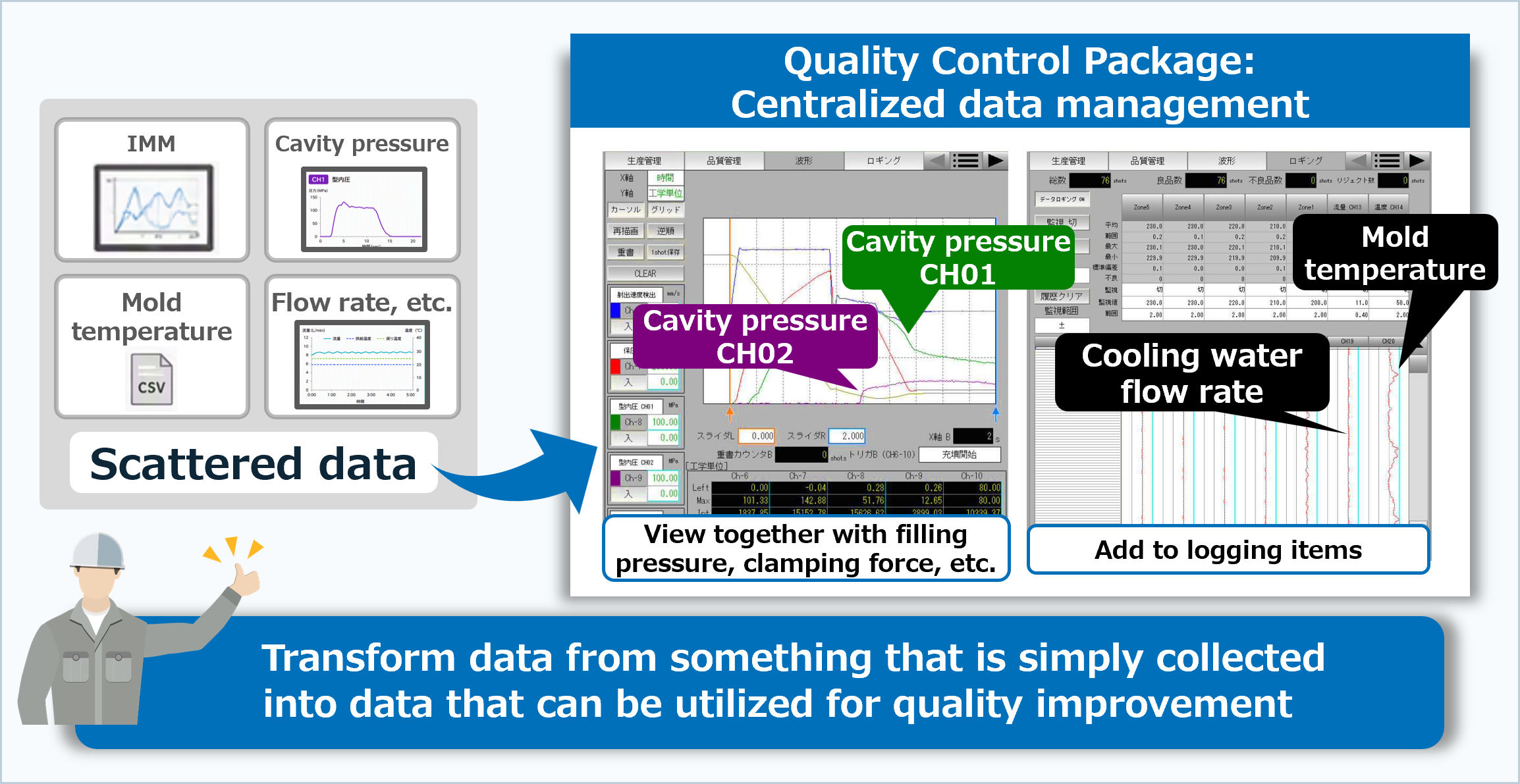
In this way, centralizing data through the Quality Control Package makes analysis, monitoring, and recording more efficient.
Transforming sensor data that was previously "only collected" into "data that can be used for quality improvement" is one of the major values of the Quality Control Package.
Benefits of Implementation
Reducing the Time Required to Check and Analyze Quality Data
In quality management operations, there are many occasions when necessary data must be extracted from historical records, not only for defect analysis but also when responding to customer inquiries, conducting quality audits, or reviewing production history.
When molding machine data and sensor data are managed in separate systems, each set of data must be searched from a vast amount of information and the corresponding shots must be accurately matched. As a result, each task tends to take a considerable amount of time.
By centralizing data with the Quality Control Package, daily working time and workload can be reduced, leading to significant improvements in operational efficiency.
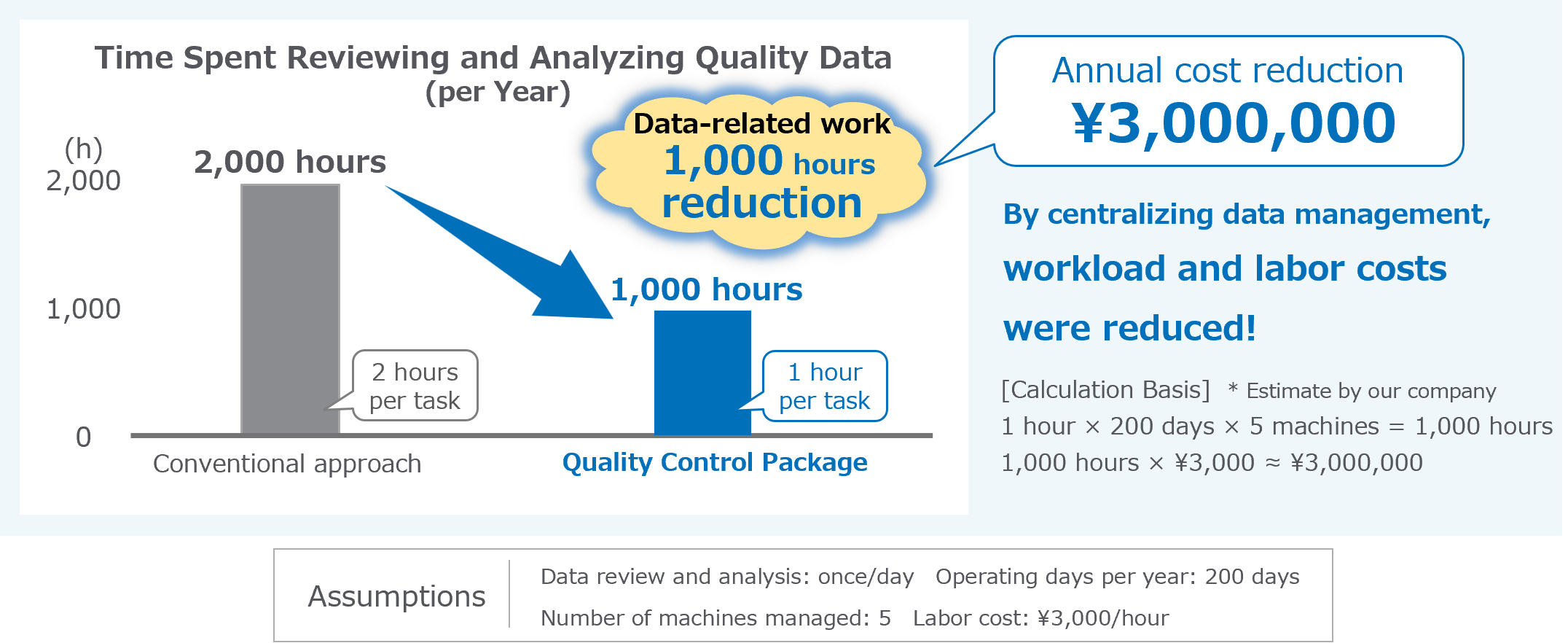
According to our estimates, for example, a data extraction and analysis task involving 5,000 shots that previously required two hours per operation is expected to be reduced by half through data centralization.
Assuming this task is performed once a day, 200 days a year, at a production site managing five machines, this would result in a reduction of 1,000 work-hours per year.
This reduces the time required for data checking and analysis while also easing the workload and improving operational efficiency.
Reducing Material Waste Through Improved Pass/Fail Judgment Accuracy
In quality management, products with even the slightest suspected abnormalities may be classified as defective to prevent defective products from reaching customers.
However, when judgments are based only on molding machine data, products that are actually good may sometimes be rejected as defective "just to be safe."
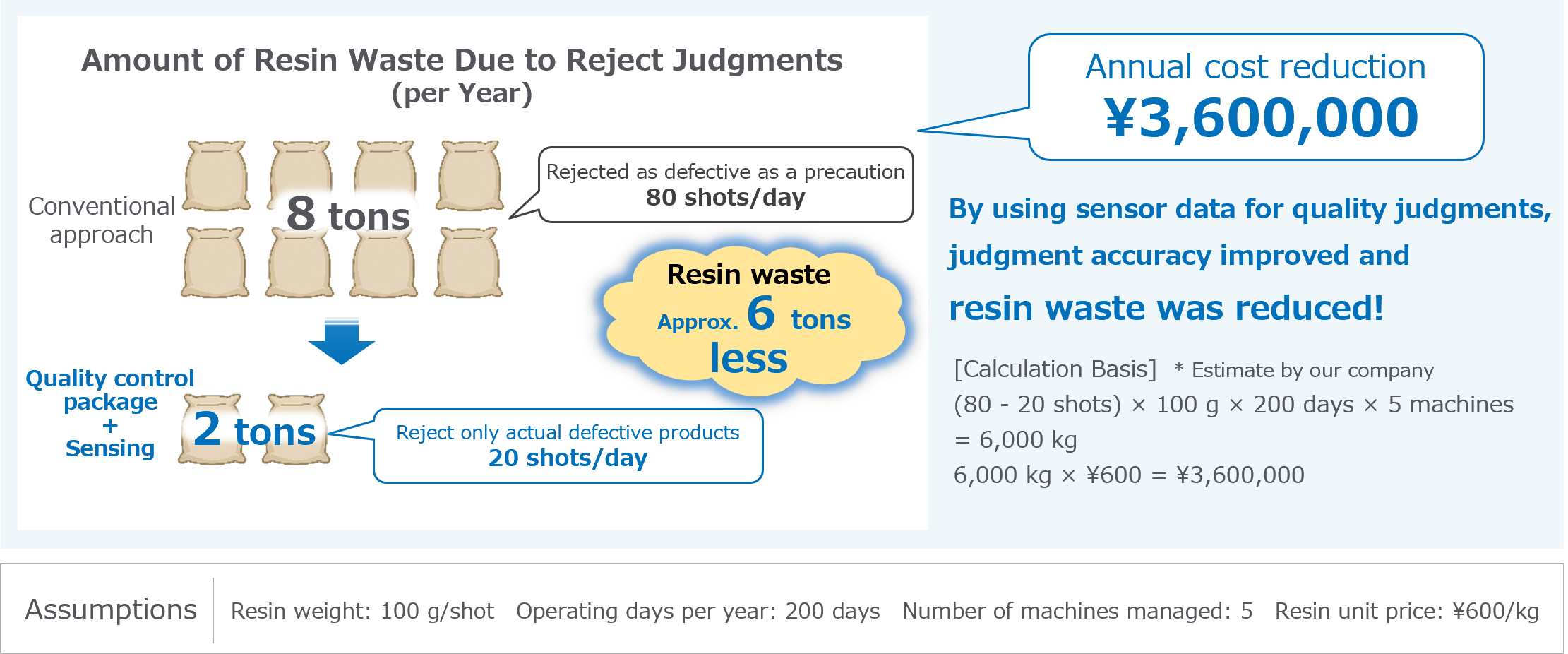
By adding sensor data that has a high correlation with product quality, such as cavity pressure data, mold temperature, and mold cooling water flow rate, to the parameters being monitored, pass/fail judgments can more accurately reflect the actual product condition. As a result, good and defective products can be distinguished more accurately, helping reduce unnecessary disposal.
For example, consider a production site where 80 shots per day are judged to be defective "just to be safe" when judgments are based solely on molding machine data.
If adding sensor-data monitoring makes it possible to determine that 60 of those shots are actually good products, and each shot uses 100 g of resin, resin consumption can be reduced by 6 kg per day. At a production site managing five machines and operating 200 days per year, this would result in a reduction of 6 tons of discarded resin per year. Furthermore, assuming a resin price of 600 yen/kg, annual material loss could be reduced by 3.6 million yen.
In addition to material costs, this can also reduce the work involved in reusing or disposing of defective products and help increase production output.
We also introduced Futaba Corporation's cavity pressure sensors and our Quality Control Package at the "Practical Seminar on Molding Optimization and Equipment Management," recently held at our Osaka Technology Center, where we shared know-how on defect countermeasures, waveform management, and equipment maintenance.
 Scenes from the seminar
During the seminar, a demonstration was conducted using Futaba Corporation's "cassette-type resin test mold," which improves efficiency during setup changes. Participants were able to observe changes in cavity pressure and resin temperature inside the mold as waveform data on the molding machine screen, while also seeing how data can be collected and utilized with the Quality Control Package.
A representative from Futaba Corporation also explained, using actual examples, how data obtained through sensing can be utilized when determining molding conditions. The specific approach of visualizing conditions inside the mold and utilizing the data for quality management and defect analysis attracted particular interest from participants, and many questions were raised with actual operation in mind.
 Left: Cassette-type resin test mold and cavity pressure sensor wiring Right: Pressure and mold temperature relay amplifier
The first step in quality management is collecting data. But it is important not to stop at simply collecting it. The data must be utilized and connected to quality improvement.
By centrally managing sensor data, including cavity pressure, with the Quality Control Package, conditions inside the mold that cannot be directly observed can be visualized, while analysis, monitoring, and recording can be made more efficient.
We encourage you to consider combining the Quality Control Package with cavity pressure sensing as a system for utilizing collected data to improve quality.
The functions introduced in this article can be experienced through our "Popular Feature Demonstrations" held at the Chiba Technology Center. Please feel free to contact us.
▶View details of the "Popular Feature Demonstration"
If you would like to see the actual operation screens of the Quality Control Package introduced in this article, please refer to the article above.
*The Quality Control Package is an optional function.
Contact us
For any questions regarding this article, please contact ushere.