In mass-production injection molding, completing the initial process setup does not always mean that production can continue without concern. Even small changes --such as a resin lot changeover, fluctuations in ambient temperature, or changes in mold temperature-- can gradually affect the molding process. Over time, these changes may lead to defects such as short shots, flashes, or sink marks. As a result, the machine may need to be stopped to re-rune process settings before production can resume.
One challenge that has become increasingly serious in recent years is labor shortage. Adjusting molding conditions often requires the knowledge and experience of skilled operators. At the same time, more production sites are facing concerns about unattended operations during nights and holidays, as well as the need for a limited number of operators to oversee multiple machines.
"I want to step away from the machine, but I can't."
"Only a few operators have the skills needed to respond when something goes wrong."
"If the machine stops frequently and recovery takes time, productivity will not improve."
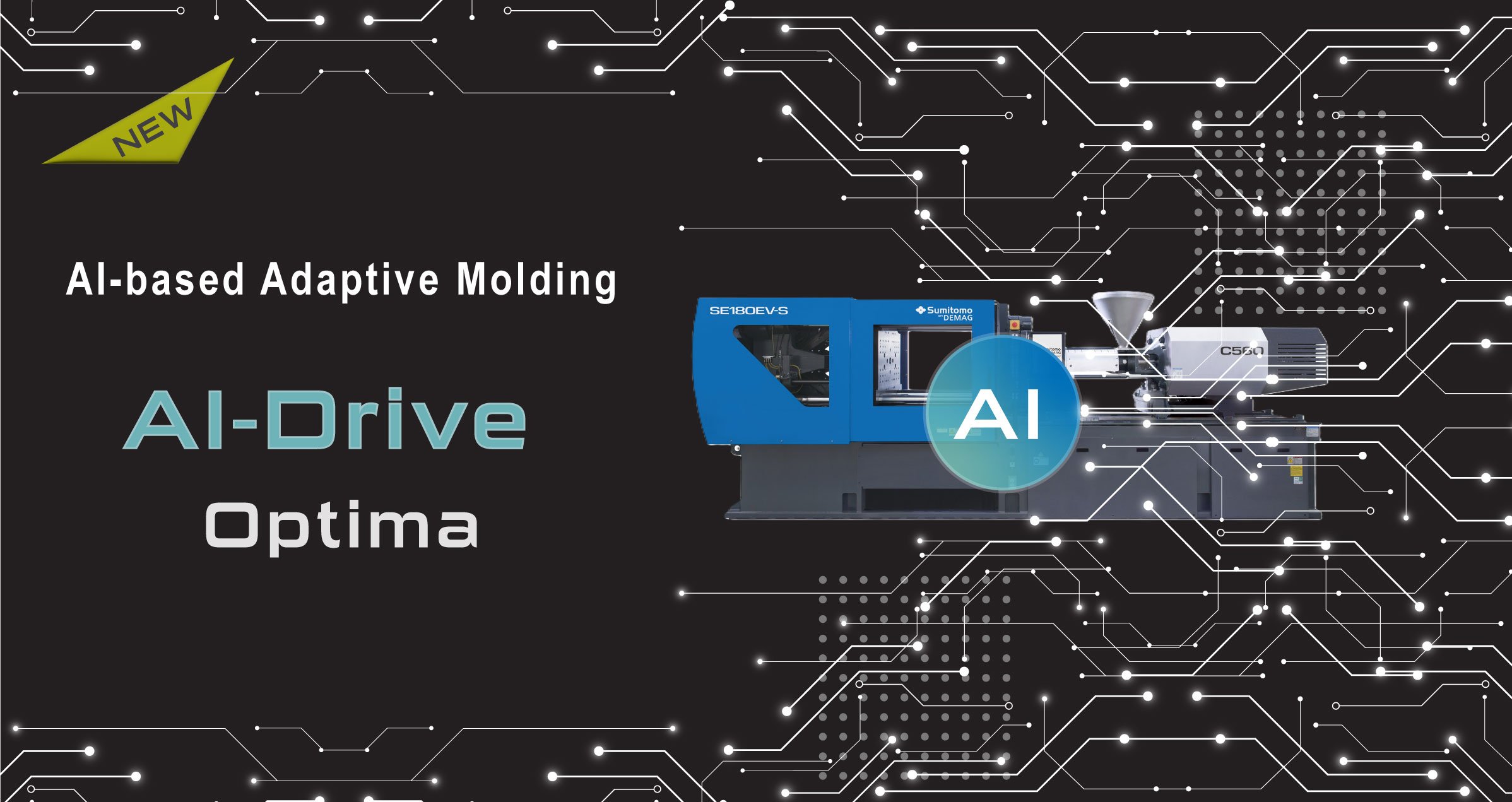
To address these concerns from molding managers and support labor-saving operations, we have released AI-Drive Optima, an AI-based function that automatically adjusts molding conditions during mass production.
A function based on a similar concept was exhibited as a reference at a trade show in 2024. At that time, however, operation depended on an external device. With the newly released AI-Drive Optima, AI is built into the injection molding machine itself. Because no connection to external equipment is required, introduction and management are smoother and more straightforward.
AI Learns Process Trends and Supports In-Process Tuning During Mass Production
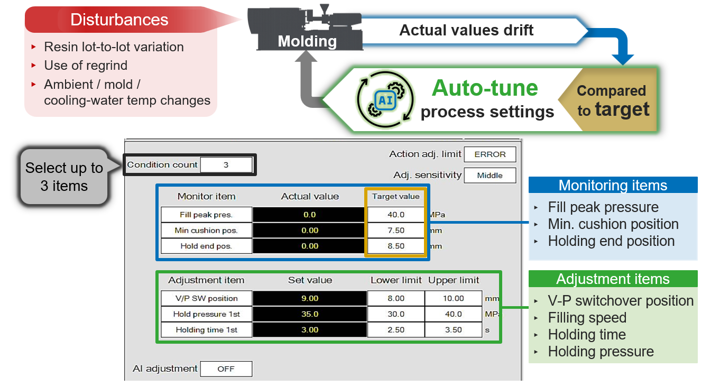
AI-Drive Optima compares each shot's actual values for selected monitoring items, such as fill peak pressure and minimum cushion position against target values. It then automatically adjusts process settings such as V-P switchover position, filling speed, and holding pressure to keep those actual values as close to the targets as possible. By quickly responding to gradual changes caused by disturbances, AI helps prevent monitored values from drifting away from the target range. In this way, AI-Drive Optima supports stable molding within an optimal operating window during mass production.
Let AI Handle Complex Process Adjustment
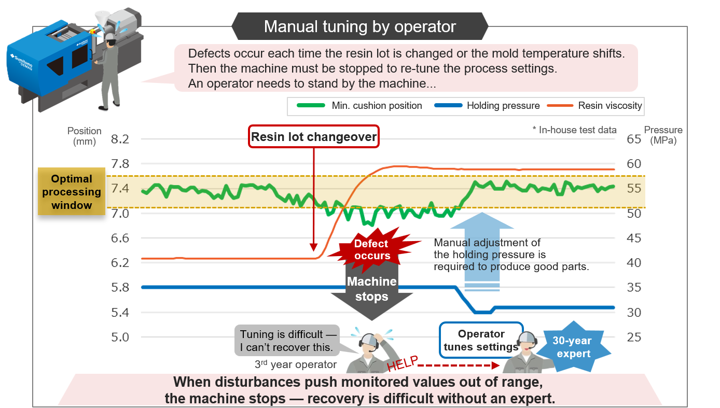
In mass-production molding, resin lot changeovers are a common source of variation, as each lot has a slightly diverse resin viscosity. This can affect the minimum cushion position, causing it to move outside the acceptable range and potentially leading to molding defects. This challenge can be seen at many molding sites.
When defects occur, the machine may stop, and an on-site operator tries to adjust the process settings. However, deciding which parameter to change and how much to change it requires experience and technical knowledge. Operators must quickly determine the right balance among multiple interacting conditions, often within a limited amount of time. This can be a major burden, especially for those with less experience. As a result, process recovery has often depended on the judgment of highly skilled operators. In some cases, production becomes reliant on specific individuals, and recovery may take longer than desired.
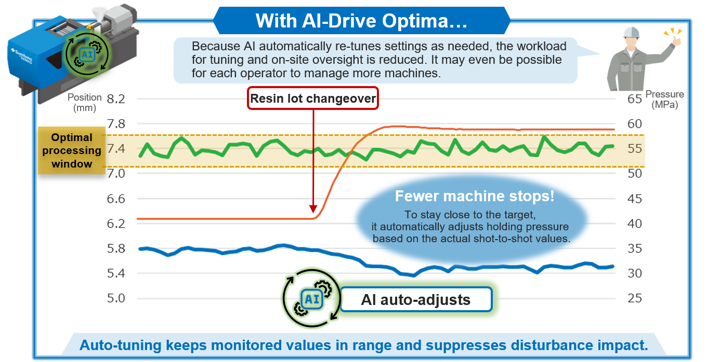
Because AI can adjust process settings before monitored values go out of range, it helps reduce the impact of disturbances. Through machine learning, AI automatically determines which parameters should be adjusted and by how much. It then fine-tunes multiple conditions as needed, helping suppress defect occurrence and reduce the number of machine stops.
Reducing machine downtime can contribute to improved productivity. In addition,
it can help reduce the effort required for process tuning,
=> allowing mass production to continue even when an experienced operator is not immediately available.
it can help reduce the effort required for monitoring and patrols,
=> supporting desk work during production as well as unattended operations during nights and holidays
=> fewer entries are also required in controlled environments such as cleanrooms.
Furthermore, by reducing molding defects and short interruptions, AI-Drive Optima can contribute to reducing resin loss. When regrind is used, changes in the mixing ratio sometimes affect molding quality. In such cases as well, AI can automatically re-tune the process settings as needed, helping operators use regrind with greater confidence.
Mass Production That Does Not Depend Too Heavily on Individuals
The goal of AI-Drive Optima is not simply to "reduce people." Rather, it is to help production sites operate reliably with limited personnel by allowing AI to complement the knowledge and experience of skilled operators. If your production site faces challenges with in-process tuning, machine monitoring, labor shortages, or unattended operation, AI may become a valuable new partner.
For more information, including details on applicable models and operating conditions, please contact us.
Contact us
If you are interested in AI-Drive Optima, would like to request a quotation, or have any questions,
please contact us through the web inquiry form.